Sewer Pipe and Well Pressure Washing
Cleaning of external lines, connection manholes, inspection chambers, and internal flat sections with high-pressure nozzles – removing grease, sediment, sand, and mud layers from pipe walls.

Sewer pressure washing in Tallinn and Harjumaa – order high-pressure cleaning of sewer pipes, lines, stacks and grease traps from ToruFix. We clean external lines, apartment building stacks, wells and stormwater systems, and vacuum out sewage, sludge and sediment. We work for private clients, apartment associations and businesses – scheduled or emergency.
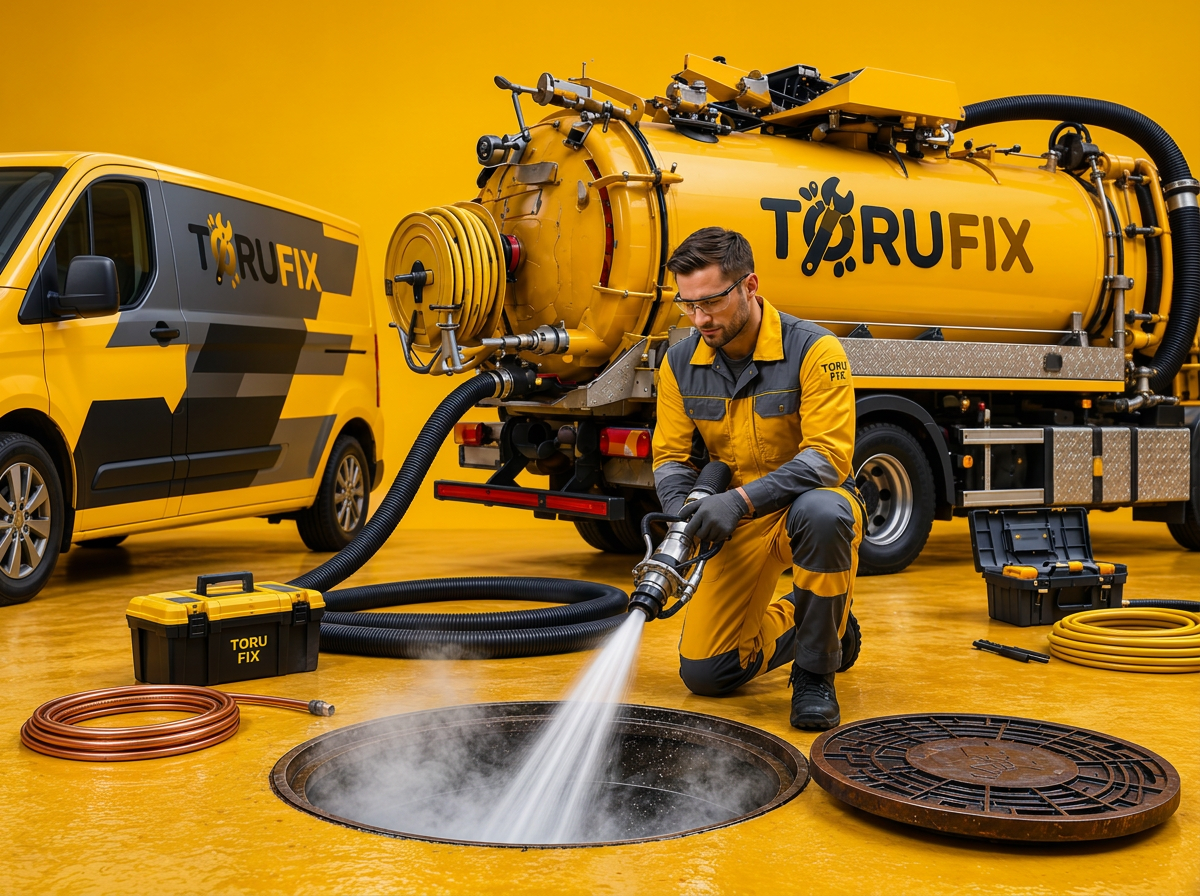
Cleaning of external lines, connection manholes, inspection chambers, and internal flat sections with high-pressure nozzles – removing grease, sediment, sand, and mud layers from pipe walls.
Cleaning of vertical sewer stacks in apartment buildings with hot water pressure washing equipment, for situations where cold water can no longer tackle thick grease layers.
Emptying and pressure cleaning of catering grease traps, vacuuming of sand and sediment layers from stormwater grate drains, and subsequent washing.
Emptying of septic tanks, collection tanks, sediment tanks, and dry toilets with a vacuum truck, including transportation and disposal of sewage and sludge.
Pressurization of water, heating, and sewage pipelines to check for tightness before or after repairs.
High-pressure cleaning of lines between buildings and connection manholes, communal sewer outlets, and long external sections using a pressure washing truck.
Emptying of wells and tanks with a vacuum truck, followed by pressure washing of walls, bottom, and outlet pipe to effectively restore volume and flow.
Post-cleaning internal pipe inspection with a camera: determining if the blockage was caused by sediment or by a collapse, crack, incorrect connection, or root intrusion at a joint.
Dispetšer vastab ööpäevaringselt. Peatame kahju leviku, lokaliseerime lekke ja sõidame välja ka öösel ning pühade ajal.
+372 58 024 476Pressure washing, or high-pressure washing, is the most effective way to clean sewer pipes, lines, stacks, wells, and grease traps. A high-pressure water jet directed into the pipe removes grease, sediment, sand, and mud layers from the pipe walls, restoring its original flow capacity. Unlike snaking, pressure washing doesn't just create an opening in the blockage for a momentary flow – it thoroughly cleans the pipe walls, delaying the accumulation of new sediment.
Sewage removal is the natural counterpart to pressure washing. Sediment dislodged from a well, septic tank, or grease trap during cleaning needs to go somewhere: a vacuum truck suctions it into its tank, transports it, and delivers it to a reception point. This is precisely why these two services are usually ordered together, allowing a well to be both emptied and cleaned in a single visit.
ToruFix OÜ provides pressure washing services in Tallinn and Harjumaa for private clients, apartment associations, and businesses: sewer jetting, sewer pipe jetting, pipeline and line pressure washing, stack cleaning, grate drain and drainage cleaning, grease trap cleaning, and septic tank and collection tank emptying. We offer services for both planned maintenance and emergency call-outs, 24 hours a day.
This page explains what pressure washing does and doesn't do, when snaking is sufficient, how work is performed in apartment buildings, private homes, and commercial premises, how often cleaning is needed, what determines the scope of work, and how to place an order. If you'd like an immediate quote, please call or submit an inquiry using the form – we will respond based on the type of object and description of the problem.
A pressure washing unit consists of a water tank, a high-pressure pump, a hose reel, and interchangeable nozzles. The hose is inserted into the pipe via a manhole or inspection opening, and the rearward-facing jets on the nozzle propel the hose forward through the pipe. Simultaneously, the water jets dislodge grease, sediment, and limescale layers from the pipe walls, which are then carried by the water flow back towards the manhole for extraction.
The pressure and water volume are selected based on the pipe material, diameter, and condition. A cast-iron pipe in an old apartment building basement requires a different regime than a new PVC line or a thick-walled concrete pipe. Incorrect pressure or nozzle can damage a pipe in poor condition, making the technician's assessment before starting work as crucial as the machine's power.
Nozzles serve different purposes. A cleaning nozzle is designed to wash away sediment and grease from pipe walls; a penetrator nozzle first creates a channel through dense blockages; a rotating nozzle tackles hard limescale and grease crusts; and a root cutter nozzle severs fine roots that have grown into the pipe through joints. Typically, several nozzles are used sequentially on a single job.
Hot water pressure washing is an advanced level of cleaning. Hot water melts grease before the jet pressure dislodges it, making it particularly effective for apartment building stacks and catering pipelines where grease layers have solidified over years. With cold water, only the central channel can be cleared in such pipes, while hot water thoroughly cleans the pipe walls.
Clients almost always ask: is snaking enough? The honest answer is, it depends on the objective. Snaking is a quick and inexpensive method to restore flow. It arrives with lighter equipment, fits into apartments, doesn't require a water supply or manhole access, and allows the family to shower again the same evening. If the blockage is caused by an incidental item or a localized clog, snaking is a perfectly adequate solution.
Pressure washing is a method for restoring the pipe's condition. If blockages recur every few months, if the pipe diameter is filled with sediment, if it's an external line or a well, or if there's grease in the pipework – then snaking only postpones the problem. A snaked pipe often has only a third of its original flow capacity because sediment remains on the walls and quickly accumulates into a new blockage.
In practice, the best combination is: snaking quickly opens the flow and resolves the immediate crisis, while pressure washing is performed as scheduled maintenance within a few days once the initial panic has subsided. This way, the client gets an immediately usable system, followed by a long-lasting solution.
A third possibility is that neither helps – and this happens more often than one might think. If a pipe has sagged, fractured, has an incorrect slope, or a joint is loose, washing provides temporary relief, and the problem recurs. That's why, for recurring blockages, we recommend a video inspection after cleaning to examine the pipe's interior, rather than repeatedly cleaning the same section every year.
The type of object determines both the technique and the duration of the work. The same service can look quite different in an apartment building, a private home, or a restaurant.
In apartment buildings, the sewage system is divided into two parts: the outlet from the appliance to the stack, owned by the apartment owner, and the stack and basement collection pipework, owned by the association. Most recurring blockages occur at this boundary – the apartment's flat outlet fills with grease over years, and the communal stack accumulates sediment at the lower bend.
For an apartment association, scheduled pressure washing means three things at once. First, it eliminates most emergency call-outs, which often happen at night and cost significantly more. Second, it reduces the risk of sewage backing up into lower-floor apartments – this damage can take months to process between insurance and the association. Third, maintenance costs are predictable and fit within the budget.
During the work, we usually move upwards from the basement: first, we clean the horizontal collection pipework, then the stacks via the roof outlet or the upper-floor inspection opening. Residents must be notified, as the sewage system should not be used during cleaning, and in some apartments, there might be temporary odors or splashes from drains if the water seal is absent. We agree on the schedule and notification process with the association during the quotation phase.
If partial stack replacement has been done in the building or apartments have been renovated at different times, the pipework may be a mix of old cast iron and new plastic. Such transitions are common spots for blockages and should be checked separately – the result of pressure washing clearly shows whether the transition joint was properly made.
In a private home, the most common work object is the external line from the house to the connection manhole, septic tank, or communal sewer. Problems in this section are almost always threefold: sediment and grease, root intrusion through joints, and sagged sections where water accumulates.
Roots are an underestimated danger in Estonian private homes. Trees or hedges seek moisture and find the smallest imperfection in joints. Initially, root clumps only catch paper, then continuous slow drainage occurs, and finally, a complete blockage. Pressure washing with a root cutter nozzle severs these and restores flow, but if roots regrow every year, the joint needs to be excavated and repaired.
The stormwater system and grate drains require maintenance in spring after the sanding season ends. Sand and leaves accumulated at the bottom of the well reduce its volume, block the outlet, and with the first heavy rain, water pools in the yard, in front of the garage, or flows into the basement through windows. A vacuum truck removes the sediment layer, and pressure washing cleans the well walls and outlet pipe.
The same applies to drainage pipework. If the drainage around the house is filled with sand and mud, it can no longer drain groundwater, and moisture problems in the foundation and basement begin slowly and unnoticed. Lower pressure and a smaller nozzle are used for drainage cleaning, as the pipework is thin-walled and perforated.
For a catering establishment, regular emptying and pressure cleaning of the grease trap is part of the job, not an optional extra. The grease trap collects grease and food residues from kitchen wash water before they reach the communal sewer. If the trap is not emptied, grease starts to move further and solidifies in the pipework – at which point it becomes a problem for the entire connection, not just a single device.
A clogged grease trap means kitchen downtime at the worst possible moment, usually during peak evening hours. The cost of downtime for one evening is often greater than a year's worth of scheduled maintenance. Therefore, we agree on a schedule with commercial clients and arrive before opening or after closing, so that kitchen operations are not interrupted.
During cleaning, we empty the trap with a vacuum truck, wash the walls and baffles with pressure washing, check the inlet and outlet, and refill the trap with clean water. The removed contents are disposed of responsibly. If necessary, we also clean the kitchen floor drains and the outlet up to the connection manhole during the same visit, as grease usually reaches there too.
In commercial and industrial areas, the specifics relate more to access and time windows: the well might be in a parking lot, a storage area, or under a production line, where work can only be done at a specific time. During a site visit, we agree on access, safety, and working hours in advance to ensure the team doesn't have to wait on-site.
Sewage removal service involves emptying a well or tank with a vacuum truck, transporting the contents, and delivering them to a reception point. The most common objects are collection tanks, septic tanks, sediment tanks, dry toilets, and sand traps. The client's task is to ensure vehicle access and indicate the well's location; if the well is under snow, soil, or a terrace, it must be cleared beforehand.
The frequency of septic tank emptying depends on the tank's capacity and the household size. For a three-chamber septic tank, a typical frequency is one to two times a year; for a collection tank, it depends entirely on water consumption. If you monitor the tank yourself, it's advisable to check the level and order removal before it overflows – cleaning an overflowing tank is more expensive and unpleasant.
An important technical nuance for septic tanks: after emptying, the chambers usually need to be refilled with water, as an empty plastic tank can float up in soil with high groundwater, ripping apart pipe connections. Our team does this by default, unless the manufacturer's instructions state otherwise.
It's worth ordering well pressure washing along with emptying. Simply pumping out the liquid leaves the sediment layer at the bottom and on the walls, causing the well to fill up faster than necessary. With washing, the tank is truly clean, and the next emptying will be needed later.
Work begins with a phone call or a form submission. We'll ask about the type of object, a description of the problem, the location and access to the well or inspection opening, and whether it's an emergency or scheduled maintenance. Based on this information, we select the appropriate equipment: a lighter pressure washing unit, a large pressure washing truck, or a combined machine with a vacuum unit.
Prophylactic cleaning is almost always cheaper than rectifying emergency consequences. Flooding in an apartment or basement leads to damage to flooring, partition walls, and furnishings, drying costs, and disputes between neighbors – sums for which a maintenance bill is marginal.
Recommended frequencies are as follows, but the actual schedule depends on what the pipework actually reveals. If the first cleaning uncovers a very thick sediment layer, we shorten the interval; if the pipework is clean, the interval can be extended.
A large part of the cost comes from the time spent traveling, locating wells, and ensuring access. The more preparatory work is done, the shorter the team's presence on site.
The most common mistake is excessive use of chemicals. Store-bought clog removers don't dissolve the grease layer in pipes, but they corrode old metal pipes and make subsequent work dangerous – the technician has to consider that corrosive mixture is in the well. If a product didn't help the first time, five bottles won't either.
Another mistake is pouring grease down the sink. Cold grease immediately sticks to the pipe wall after the first meter and collects everything that follows. Wet wipes and hygiene products that don't break down do the same – they are the biggest source of modern sewage blockages.
The third mistake is postponing maintenance until the system completely fails. A slow-draining sink, a gurgling drain, or an odor in the basement are early signs where a team called in promptly can do the job in an hour, which a month later could mean an emergency night call and a cleanup.
The fourth mistake is assuming that cleaning will fix a construction flaw. If a pipe has the wrong slope or has sagged, no nozzle can change the laws of physics. In such cases, the only permanent solution is to repair or replace the section, and we will state this, rather than selling another cleaning.
Pressure washing operates with pressure that is dangerous to humans, and well work involves dealing with wastewater and gases. Therefore, the work area is restricted, an open well is left unattended only if properly barricaded, and the team uses protective equipment. We ask that children and pets are not present in the work area during cleaning.
Inside buildings, we cover the work area and use inspection openings to prevent splashes from damaging interior finishes. If the pipework is in poor condition, we will inform you of the risk before work begins: a heavily corroded cast-iron pipe can rupture during cleaning, and the correct solution then is section replacement, not higher pressure.
Removed contents are handled according to prescribed procedures and delivered to a reception point. For commercial clients and apartment associations, we issue a proper invoice with a detailed work description, suitable for both accounting and explanation at general meetings.
In practice, pipework pressure washing is divided into three distinct types of work: internal building pipework, vertical stacks, and external lines. Each has its own access, typical type of dirt, and working method, although clients order them under the same name – pressure washing.
Line pressure washing means cleaning the section between a building and a connection manhole or communal sewer. These are long, underground pipes, usually of larger diameter, accessible only via a manhole or inspection opening. The work is mostly done with a pressure washing truck, as it requires both water volume and a long hose.
Typical problems for external lines include sand and sediment in lower-slope sections, grease near the building, and root intrusion through joints. Cleaning is done section by section from well to well, so that sediment moves in a controlled manner to one location, where it can be pumped out by a vacuum truck, rather than continuing into the communal sewer.
Stack pressure washing is a service for apartment buildings and office buildings. Vertical stacks accumulate grease and soap scum uniformly along their entire height and typically clog at the lower bend where flow slows down. Cleaning is done from top to bottom via the roof outlet or upper-floor inspection opening, with the basement or well below serving as the collection point.
If grease has solidified, we use hot water pressure washing: hot water softens the layer, and the jet pressure dislodges it from the wall. With cold water, only the central channel can be cleared in such a stack, which will re-clog within a few months. For apartment associations, we usually clean stacks floor by floor on a schedule, with resident notification.
Internal pipework within an apartment or house – sink, shower, washing machine, and toilet outlets up to the stack or collection pipe – is cleaned with smaller equipment that fits indoors and operates at lower pressure. This is where pressure washing yields the most noticeable results for greasy kitchen lines, where snaking only creates an opening.
We select equipment based on the object, not the other way around. There's no point in ordering a large machine for a small apartment outlet, and a compact unit whose water tank empties before the job is halfway done won't clean a large external line.
A pressure washing truck is designed for external lines, wells, and large-diameter pipework: it has a large water capacity, a long hose reel, and sufficient pump power to wash tens of meters continuously. A combined machine adds a vacuum pump, which immediately suctions dislodged sediment into the tank during cleaning – eliminating the need to order a separate vacuum truck and completing the job in one visit.
High-pressure washing for sewers always involves the interplay of two parameters: pressure and water volume. Pressure breaks up the layer, and water volume carries it away. For large-diameter pipes, water volume is even more important than maximum pressure, because without flow, sediment won't move to the well with just a jet.
For smaller jobs and those performed indoors, we use compact pressure washing units and hot water cleaning where grease has solidified. Pressure and nozzle are chosen according to the pipe material and condition – old cast iron, concrete, and new plastic tolerate different regimes.
Our primary service area is Tallinn and Harjumaa. We perform pressure washing in Tallinn across all districts – Lasnamäe, Mustamäe, Õismäe, Kesklinn (City Centre), Kristiine, Põhja-Tallinn (North Tallinn), Nõmme, Pirita, and Haabersti – in old apartment buildings as well as new developments and commercial properties.
Pressure washing in Harjumaa covers the areas of Viimsi, Harku, Saue, Saku, Kiili, Rae, Jõelähtme, Raasiku, Kose, Anija, Kuusalu, and Loksa. Outside dense urban areas, it typically involves a private home's external line, septic tank, collection tank, or drainage system – there, access and the well's location are the most crucial information, which we can clarify by phone before dispatch.
For larger projects and scheduled maintenance, we travel elsewhere in Estonia by agreement. For emergency call-outs in Tallinn, we typically arrive within 30–60 minutes; in Harjumaa, within 1–2 hours. For scheduled pressure washing, we arrange a time window that suits you, usually on weekdays for apartment associations and outside opening hours for catering establishments.
Pressure washing is not a service with a single fixed price, as the scope of work depends on what the pipework actually reveals. We provide an estimate over the phone based on the object's description and confirm it on-site before starting work – we never begin work without the client knowing what will be done and to what extent.
Four factors most significantly impact the scope: the length and diameter of the section to be cleaned, access to the well or inspection opening, the amount of sediment and grease, and whether there is material to be removed and how much. For grease traps or septic tanks, the volume to be emptied and disposal costs are added.
Ordering is done in two ways: by calling or submitting an inquiry via the form. For urgent situations – well overflowing, basement flooding, kitchen out of service – please call, as we can then dispatch a team immediately and clarify details en route.
For scheduled maintenance, the form is sufficient. Please provide the object type and address, what system needs cleaning, whether the blockage has recurred and how often, if the well location is known, and what time suits you. Apartment associations typically add the number of floors and stacks, commercial clients the desired time window.
In response, we will provide an estimated scope and time, and arrange the visit. At the end of the job, we will show the results, explain what we observed in the pipework, and recommend the next maintenance schedule – or honestly advise if the section requires repair instead of cleaning.
Pressure washing is rarely a standalone service. More often, it's part of a larger solution: first, flow is restored, then what's actually happening inside the pipe is inspected, and only then is a decision made about repairs.
If the cleaning results don't last, the next step is a video inspection. If the inspection reveals a sagged or fractured section, then sewer pipe replacement is considered. If the problem is a recurring blockage in one apartment, often clearing the blockage along with cleaning the outlet is sufficient. For local sewage systems, cleaning and emptying are part of septic tank maintenance or installation.
Oleme 24/7/365 kõikjal Tallinnas ja Harjumaal.
Tuleme kohale kiiresti ja lahendame probleemi kohapeal.
Teeme tööd korrektselt ja anname garantii.
Selge hinnainfo enne tööde algust, üllatusi ei tule.
Aitame vormistada kahjujuhtumeid kindlustusseltsidele.
Helista või kirjuta – kirjelda probleemi paari lausega.
Ütleme tunnihinna ja eeldatava mahu enne kohalesõitu.
Tallinnas tavaliselt 30–60 minutiga, oma tehnika ja varuosadega.
Teeme töö, kontrollime süsteemi ja anname garantii.
Rapid clog removal using snaking and pressure washing in apartments, private homes, and commercial premises.
Clog RemovalMethods, maintenance, and prevention for cleaning sewer pipe systems.
Sewer CleaningCamera inspection that reveals whether the problem is sediment or a structural pipe defect.
Video InspectionReplacement of sagged, fractured, or deteriorated pipe sections and stacks.
Sewer Pipe ReplacementLocal sewage solutions, septic tank installation, and maintenance.
Septic Tank InstallationAdvice article: signs, timing, and reasons why problems recur.
When to Pressure WashSnaking creates an opening in a blockage and quickly restores flow, while pressure washing cleans pipe walls of grease, sediment, and sand. For a one-time blockage, snaking is sufficient; for recurring blockages, external lines, or greasy pipework, pressure washing is the only lasting solution.
Pressure and nozzles are selected according to the pipe material and condition – cast iron, concrete, and plastic tolerate different regimes. If the pipework is very corroded, we will inform you of the risk before work and, if in doubt, recommend a video inspection first.
Cleaning a single apartment outlet or one well typically takes 1–2 hours. Pressure washing for apartment building stacks and basement pipework usually takes half a day to a full day, depending on the number of floors and the pipework's condition.
Yes. The vacuum truck pumps dislodged sediment and liquid into its tank and transports it for disposal. We also empty septic tanks, collection tanks, sediment tanks, sand traps, and dry toilets.
Yes, water should not be run or toilets flushed during cleaning, as water flows in the opposite direction in the pipework. In apartment buildings, we notify residents in advance and agree on a time window with the association that is least disruptive to residents.
We recommend prophylactic pressure washing every 2–3 years. If the building has high kitchen usage with a lot of grease or old cast-iron pipework, the interval should be shorter – the first cleaning will indicate, by the sediment layer, what schedule is sensible.
Mostly, the reason is that only snaking was done previously and sediment remained on the walls, or there's a structural fault in the pipe section – a sag, incorrect slope, loose joint, or root intrusion. A video inspection provides a definitive answer to this.
Yes. For catering and commercial properties, we work before opening or after closing to ensure kitchen operations are not interrupted. We agree on a schedule in advance and arrive within the agreed time window.
Yes. We pressure test water, heating, and sewage pipelines to check for tightness before accepting repairs or in case of suspected leaks. This is a separate service from pressure washing, although the name is similar.
Yes. Our emergency service operates 24/7/365, including public holidays. Nighttime and holiday call-outs are tariffed higher than weekday visits, but prompt intervention is almost always cheaper than the consequences of waiting until morning.
Yes, we provide a warranty for both the work performed and the materials we install. We issue a proper invoice, suitable for submission to both apartment associations and insurance companies.
Our primary service area is Tallinn and Harjumaa, but we travel throughout Estonia. In Tallinn, we usually reach emergency call-outs within 30–60 minutes; in Harjumaa, within 1–2 hours.
Essentially, there is no difference – both refer to cleaning pipework with a high-pressure water jet. In common parlance, 'pressure washing' is used, and in technical descriptions, 'high-pressure washing'. The name is not important; what matters is whether the pressure and water volume used are suitable for the specific pipe diameter, material, and type of dirt.
Mostly yes, as the hose reel has sufficient length for the truck to remain on the road or at the edge of the yard. If the well is behind a fence, on a steep slope, or on soft ground, we clarify access before dispatch and choose suitable equipment to avoid damaging landscaping or driveways.
It is suitable if the pipe is intact. For old cast iron, we start with a lower pressure regime and observe how the pipe reacts. If the wall is corroded through or a joint is loose, a video inspection usually reveals this – then we recommend section replacement instead of cleaning, as cleaning will not repair such a pipe.
In a typical apartment building, a reasonable interval is 2–3 years; in buildings with active kitchen use and old cast-iron stacks, more frequently. For catering and grease trap sites, the schedule is significantly more frequent and depends on kitchen turnover.
No. The work is planned so that sediment moves in a controlled manner to a well or collection point, from where it is pumped out by a vacuum truck. Indoors, we cover the work area and clean up after ourselves – this is part of the service, not an extra charge.
Sõidame välja kogu Eestis. Avariitööd ööpäevaringselt, 7 päeva nädalas.