Hidden Water and Heating Leak Detection
Locating leaks in pipes hidden within floors, walls, or ceilings using thermal cameras, acoustic devices, and pressure testing, without prematurely damaging surface finishes.

We locate hidden water leaks within floors, walls, and ceilings: heating pipes, domestic water pipes, underfloor heating, heat substations, and manifolds. We use thermal cameras, acoustic leak detectors, pressure tests, and trace gas to pinpoint the leak location as accurately as possible, allowing us to open only the specific small area where the leak actually is. Available in Tallinn and Harjumaa, 24/7 for emergencies.
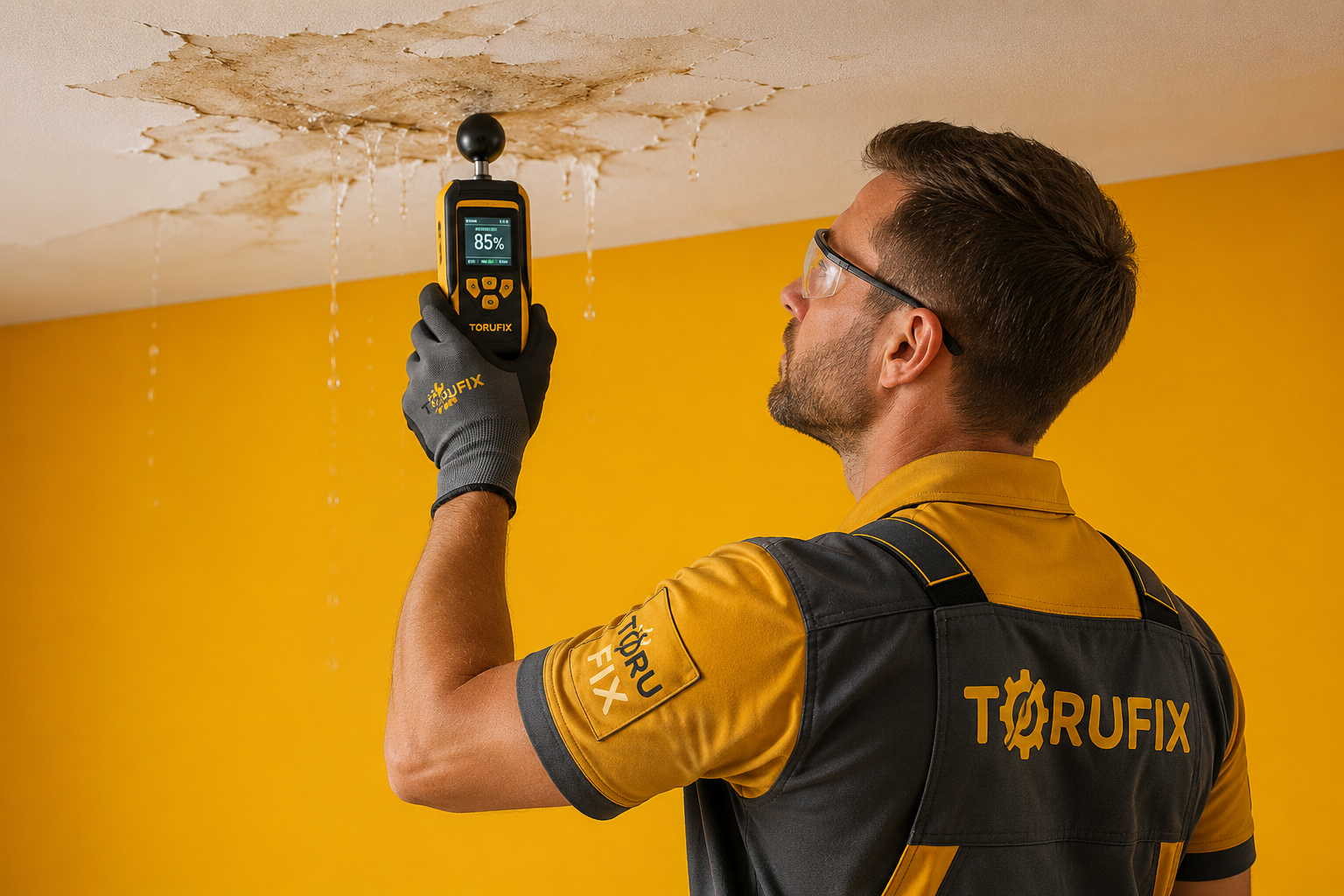
Locating leaks in pipes hidden within floors, walls, or ceilings using thermal cameras, acoustic devices, and pressure testing, without prematurely damaging surface finishes.
Pressure testing and individual circuit inspection of underfloor heating, checking the manifold cabinet and connections, and identifying damaged circuits.
Moisture measurement, clarifying the origin of mould and stains, and determining whether the issue is a leak, condensation, or external moisture.
After locating the leak, we can perform immediate repairs: pipe section replacement, connection restoration, pressure testing, and system refilling.
Dispetšer vastab ööpäevaringselt. Peatame kahju leviku, lokaliseerime lekke ja sõidame välja ka öösel ning pühade ajal.
+372 58 024 476A hidden water leak is one of the most costly problems a building can face. Unlike a dripping tap or a blocked sink, it doesn't immediately announce itself: water seeps into concrete, screed, or insulation, travels along slopes to a completely different location, and only becomes visible when the flooring, wall finish, or neighbour's ceiling is already damaged. By this point, the actual leak location is often several metres away from where the damp patch appeared.
ToruFix OÜ provides leak detection services in Tallinn and Harjumaa for flats, private houses, terraced houses, apartment buildings, and commercial properties. Our goal is always the same: to pinpoint the leak location as accurately as possible *before* any demolition, so that only a small, limited area needs to be opened, rather than half the apartment. We use thermal cameras, acoustic leak detection equipment, system pressure testing with a manometer, trace gas, and moisture meters – almost always combining several methods, as a single measurement only provides a hypothesis, not proof.
On this page, we explain how hidden leaks occur and what their first signs are, which leak detection methods are used and when each one works, what our on-site work process looks like, how leak detection differs in flats, private houses, and apartment buildings, when demolition can be completely avoided and when, unfortunately, it's necessary, and what to do right now if you suspect a leak. All content is based on cases our technicians encounter every week in Tallinn and Harjumaa.
Leak detection is a technical diagnostic service aimed at identifying the precise location of a hidden water leak without blindly dismantling structures. It is not a repair job or an opinion – it is a series of measurements that provide the client with a specific point or narrow zone where the pipe is damaged. This precision is precisely why leak detection is commissioned: every square metre of floor or wall opened without reason later incurs restoration costs that often far exceed the cost of the diagnostic itself.
The most common situation is that a client has the consequence but lacks the cause. There's a yellow stain on the neighbour's ceiling, the carpet in the hallway is warped, the tile grout in a bathroom corner is constantly dark, or the heating system pressure drops every few days. All these are symptoms that can stem from various sources: a pressure pipe, drainage, underfloor heating, a hole in the waterproofing, condensation, or even rainwater entering from the façade. The primary task of leak detection is to rule out these possibilities and identify the correct system.
Another typical reason is financial. Water meter readings increase without explanation, the apartment association's balance doesn't add up, the difference between the main meter and the sum of apartment meters grows each month. Such a continuous, yet invisible, flow rate is almost always a leak underground, in the basement, or near a riser. Here, leak detection immediately provides a financial benefit – every month the search is delayed costs real money.
The third reason is insurance and evidence. If damage has already occurred, the insurance company or apartment association will ask where the water came from and whose area of responsibility that location falls under. We provide a proper invoice and a description of the found leak location for the work performed, which can be submitted to both the association and the insurance company.
A hidden leak develops slowly and reveals itself in several stages. The earlier a symptom is recognised, the cheaper both the detection and the repair will be. The earliest sign is usually not dampness, but the system's behaviour: heating system pressure won't hold, the water heater switches on more frequently than usual, the water pump in a private house activates at night without consumption, or circulation becomes noisy. These are all indicators that water is escaping from a closed system.
The next stage is noticeable dampness. The air in the bathroom or kitchen area remains humid, tile grouts don't dry, silicone darkens, parquet begins to lift at the edges, or laminate joints swell. This is often accompanied by an odour – a musty, earthy smell that appears before mould is even visible. If moisture has reached the surface finish, the leak has usually been ongoing for weeks.
The third stage is visible damage: a patch on the neighbour's ceiling, dripping from a light fitting, a water bubble under a paint layer, salt efflorescence on a wall surface, or peeling plaster. Here, the question is no longer *if* a leak exists, but only *where* it is precisely coming from. It is in this phase that we are most often called – and it is here that accurate leak detection offers the greatest savings, as it determines how much finishing needs to be demolished.
Warm spots on the floor deserve special attention. If an area in a room with underfloor heating is noticeably warmer, or if a warm stripe appears on the floor with radiator heating, this is almost always an indication of a heating pipe leak within the screed. Heating water is warm, so a thermal camera detects such a leak particularly well – and such cases are usually resolved most quickly.
There is no single universal leak detection device. Each method only detects certain types of leaks under specific conditions, which is why we always combine them. For a typical site, we use two to four methods: the first narrows down the area, the second confirms or refutes, and the third determines the exact point. Only when at least two independent measurements point to the same location do we recommend opening the structure.
A thermal camera shows differences in surface temperature. A leak of warm or heating water heats the concrete more than the surrounding area, and the camera image reveals a characteristic expanding warm zone that follows the pipe's path. A cold water leak works the opposite way – evaporation cools the surface, creating a colder patch. This method is fast, completely non-destructive, and especially suitable for underfloor heating, hot water pipes, and pipes embedded in screed.
However, the limitations of thermography must be understood. With thick insulation, an air-gapped wooden floor, or very strong general heating, the temperature difference might not reach the surface. Therefore, we prepare for the measurement: we allow the room to stabilise, if necessary, we raise the heating water temperature or switch circuits on and off one by one to create a contrasting image.
Water escaping from a pressure pipe creates turbulence in the crack, generating sound that travels along the pipe and structure. An acoustic leak detector consists of a sensitive ground or structural microphone, filters, and an amplifier that allows listening to the specific frequency range where the leak noise is located. We move along the presumed pipe route and search for the point where the signal strength is maximal.
Acoustic detection is most effective when there is good pressure in the piping and the material conducts sound well – for example, metal pipes and pressure pipes. Plastic pipes and very small leaks dampen the signal, so we may temporarily increase the pressure or add another method if necessary. This method is also suitable for detecting leaks in outdoor and basement lines, as well as underground pipes.
A pressure test answers the most crucial question: is there a leak at all, and in which system? We isolate the section to be tested, connect a manometer or pressure pump, and observe the pressure's behaviour. A rapid drop means a large leak, a slow and steady drop indicates a small opening, and stable pressure rules out that section.
We apply the same logic section by section: we progressively isolate areas by floors, branches, manifold circuits, or taps and observe which section's isolation stabilises the pressure. This is the cheapest and most reliable way to quickly narrow down a large site before taking out any equipment.
For the most challenging cases, we use trace gas: the piping is emptied and filled with a safe gas mixture, which has much smaller molecules than water and can escape even through microscopic cracks. The gas rises through the concrete and soil, and a sensitive detector locates the exit point. This method works even when the water has already been drained and there is no acoustic signal.
Moisture meters – surface and invasive – help map the extent of moisture spread. Measurements taken with these show where the moisture is strongest and in which direction it decreases; the maximum moisture is almost always near the leak location. The same measurement is later necessary to assess whether the structure has sufficiently dried after repair.
If suspicion falls on the drainage system or a wider pipe, we use a camera inside the pipe. Video inspection reveals cracks, displaced connections, root intrusion, and incorrect gradients, and allows the distance to the leak location to be recorded in metres. This is the most direct evidence for a drainage leak and also suggests a repair solution.
Leak detection begins with a phone consultation. We ask what exactly is visible, when it started, if any repairs have been done, if the heating system pressure is dropping, and if the water meter is moving when taps are closed. These answers alone significantly narrow down possible causes and allow the technician to bring the correct set of equipment.
On-site, the work begins with an inspection and clarification of the system's logic: where risers, manifolds, shut-off valves are located, where pipes run, and when construction work was last carried out. We inspect visible damage and measure the extent of moisture. Then, we perform a pressure test to rule out entire sections, and only then proceed to precise diagnostics with a thermal camera and acoustics.
If two methods point to the same area, we physically mark the leak location on the floor or wall and discuss the next step with the client. We explain how large an area needs to be opened, what the estimated repair scope is, and if there's an alternative – for example, closing off the pipe and rerouting it along a new path without opening the old location.
In most cases, we also perform the repair immediately: we open the marked spot, replace the damaged section, restore the connection, re-pressurise the system, and monitor for sustained pressure. The work concludes with a control measurement and instructions on how to dry the structure before the finishings are restored.
The type of property determines both the choice of method and the organisation of work. The same symptom can mean a very different scope of search in a flat versus a private house.
In a flat, the piping is short but densely packed: between the bathroom and kitchen, at sink and toilet connections, and in the riser shaft. The most frequent leaks are at connections inside the shaft, in the hot water pipe under tiles, and in heating pipes within the floor. A thermal camera usually yields very good results in flats because the floor structure is thin, and the temperature difference reaches the surface.
In flats, it's particularly important to understand whether the leak falls under the responsibility of the flat owner or the apartment association. The riser and its shut-off valves are generally the association's responsibility, while the piping extending from the valve belongs to the flat owner. We document the identified leak location such that this boundary is clear.
In a private house, there is significantly more piping: water inlet, utility room, manifolds, underfloor heating circuits, boiler and water heater connections, and often outdoor lines to a well, septic tank, or outbuilding. Here, work almost always begins by isolating systems – we separately shut off the underfloor heating, domestic water, and external circuits and observe which system loses pressure.
For underground line leaks, the primary tool is acoustic leak detection combined with pressure testing, often supplemented with trace gas. This avoids digging a long trench – we only excavate at the measured point, not along the entire line.
Apartment associations typically order leak detection for two reasons: the basement is damp, or the main water meter shows more consumption than the sum of individual apartment meters. We work stairwell by stairwell and riser by riser, shutting off sections during off-peak hours and measuring meter movement under minimal consumption conditions. Such nighttime measurement provides the clearest picture, as background consumption is almost zero then.
We provide the association with a written overview of the found leak location and the recommended solution, which can be used at general meetings and for price inquiries. If necessary, we organise work so that water is cut off from apartments only during an agreed-upon timeframe.
In shops, offices, restaurants, or manufacturing facilities, time and downtime costs are critical factors. We perform diagnostics whenever possible outside opening hours, use non-destructive methods to the maximum extent, and plan any opening so that business operations can continue. For large areas, a combination of thermal imaging and acoustics is most effective, as it allows for rapid scanning of a large space.
Domestic water piping is a constant pressure system. Leaks there are often louder, faster, and acoustically well audible, but a very small drip can last for months without significant pressure drop because the pump or city water constantly compensates for the loss. This is where monitoring the water meter with closed taps provides the best answer: if the dial moves, water is escaping somewhere in the system.
A heating system is a closed loop where the water volume is fixed. Every drop that escapes lowers the manometer reading. Therefore, detecting a heating leak is fundamentally simpler – simply monitoring the pressure and isolating circuits is sufficient. Heating water is also warm, which means a thermal camera detects it in the structure much better than a cold water leak.
Underfloor heating is a separate case. Circuits are long, embedded in screed, and there are usually several of them. Our usual approach is to close all circuits at the manifold and pressure test them one by one – this quickly reveals which circuit isn't holding pressure. Only then do we use a thermal camera to pinpoint the leak on that specific circuit. This sequence prevents opening the wrong circuit.
Drainage is a pressure-free system, so pressure testing and acoustics do not work. Diagnostics there involve a filling test and video inspection, searching for cracks, displaced couplings, or incorrect gradients. A drainage leak is usually identified by its smell and periodicity – moisture appears precisely when water is being used.
The most frequent question we get on the phone is whether the floor and tiles really need to be broken up. The answer is usually encouraging: properly conducted diagnostics narrow down the leak location so precisely that often only a 30-50 cm wide area needs to be opened. This means one or two tiles or a limited section of screed, not removing the entire room's covering.
Complete avoidance of opening is possible in some cases. If the leak is located in a shaft, manifold cabinet, space under a bathtub, behind a suspended ceiling, or in a utility room, then access through a hatch or panel removal is sufficient. Sometimes, an old pipe can also be left within the structure, and a new line can be routed along a different path – for example, along the edge of the ceiling, in a channel, or behind a skirting board. Such rerouting is often cheaper than cutting concrete and restoring finishes.
Opening is unavoidable when the pipe is located within monolithic screed or concrete and a confirmed leak point exists. In such cases, it is crucial that the opening is made at the correct spot and in one go. The most expensive option for the client is not the opening itself, but multiple mistaken openings made based on assumptions without measurement – unfortunately, we see such cases quite often.
We never recommend opening a structure based on the result of a single method alone. If the thermal image and acoustic findings do not coincide, we continue searching – we add sectional pressure testing or trace gas. Only a confirmed point justifies any destructive work.
The most common mistake is waiting. A small drip doesn't disappear on its own – it enlarges the opening, saturates insulation, and eventually reaches the neighbour. Delaying for weeks usually turns a simple pipe repair into a moisture damage restoration project, the cost of which is in a completely different league.
Another mistake is to open the floor where a damp patch is visible. Water travels in the structure along a slope and emerges at the lowest or least dense point – this is not the leak location, but the exit point. This is why we always measure, rather than relying on the location of the patch.
A third mistake is to dry and finish before the cause has been found. A dryer will remove moisture, but if the pipe continues to leak, everything will recur in a few months – this time under new flooring. The correct sequence is always: find the cause, repair, dry, restore.
The fourth mistake is to leave the situation undocumented for insurance and the apartment association. Photos taken before repairs begin, thermal images, and measurement results are later the only evidence of where the water came from. We document this during the work, as it saves the client money in the long run.
Most hidden leaks don't start suddenly – they are preceded by a process that lasts for years. Old galvanised pipes corrode from the inside, press connectors installed with the wrong tool start to seep over time, and excessively hard water damages seals. Knowing the system's age provides a good forecast: metal piping 30-40 years old is already at the end of its lifespan, regardless of whether it's leaking now or not.
The simplest preventative step in a flat is to install shut-off valves so that water can be quickly turned off, and to check the water meter once a year with all taps closed. In a private house, it's worth adding a water leak sensor and an automatic shut-off valve near the main tap – this device pays for itself many times over with one prevented emergency.
For heating systems, the best prevention is regular monitoring of the manometer. If water needs to be added more than a couple of times during the heating season, it's not normal, but a hidden leak that should be located before it saturates the screed.
During major renovations, it's always advisable to photograph all pipe routes before they are covered. Such photographic evidence significantly shortens subsequent leak detection and saves both time and money.
The cost of leak detection is determined by three components: time spent, the number of methods used, and the complexity of the site. A small flat where the heating system pressure is dropping and there is no underfloor heating is usually a quick job. A large private house, where multiple systems, manifolds, and outdoor lines need to be inspected, requires more time and often multiple measurement sessions.
Site complexity increases due to lack of access, unknown pipe routes, multiple previous repairs with different materials, and situations where the system cannot be freely shut off – for example, an operational commercial property or an apartment building where shutting off water affects many residents. We clarify these factors during the initial phone call to provide a realistic time estimate.
It is always worth comparing the cost of diagnostics with the alternative. Blind opening means demolition, debris removal, new screed, new tiles, and finishing – usually many times more expensive than accurate measurement. The same applies to waiting: restoring saturated insulation and a neighbour's ceiling far exceeds the cost of leak detection.
We provide an exact price before starting work, once we have reviewed the site's symptoms and scope. There will be no unexpected additions to the bill – if an additional method is required, we will agree on it separately.
The first step is to stop the water supply to the suspected area. Close the main valve for the flat or the shut-off valve for the respective branch. If it's a heating system, do not add more water until you have noted down the manometer reading – the speed of pressure drop is valuable information for us.
The second step is to document the situation. Photograph the damp patch, write down the water meter reading and time, and take another photo an hour later. This immediately tells you if the leak is active and how large it is. If water has reached a neighbour, notify the neighbour and the apartment association in writing.
The third step is to avoid opening anything yourself. Very often, tiles are broken where water emerged, and only then is a technician called – the result is damaged finishes and still an unlocated leak. Call us before you demolish anything; often, we can already tell you over the phone what the most likely source is.
If water is actively flowing and damage is increasing by the minute, it is an emergency – our dispatcher operates 24/7, and in Tallinn, a team usually arrives within 30-60 minutes, and in Harjumaa within 1-2 hours.
Oleme 24/7/365 kõikjal Tallinnas ja Harjumaal.
Tuleme kohale kiiresti ja lahendame probleemi kohapeal.
Teeme tööd korrektselt ja anname garantii.
Selge hinnainfo enne tööde algust, üllatusi ei tule.
Aitame vormistada kahjujuhtumeid kindlustusseltsidele.
Helista või kirjuta – kirjelda probleemi paari lausega.
Ütleme tunnihinna ja eeldatava mahu enne kohalesõitu.
Tallinnas tavaliselt 30–60 minutiga, oma tehnika ja varuosadega.
Teeme töö, kontrollime süsteemi ja anname garantii.
If the identified leak is in an old pipe system, the damaged section or entire branch will be replaced.
water pipe replacementDetecting drainage leaks and cracks with an in-pipe camera.
pipe video inspectionIf heating system pressure drops, system maintenance and balancing are also part of the service.
heating system maintenanceCircuit construction and manifold solutions – essential background for understanding underfloor heating leaks.
underfloor heating installationWhen water is currently flowing and damage is increasing by the minute.
24/7 emergency serviceAll plumbing works we perform after or in conjunction with leak remediation.
plumbing works and plumbersLeak detection identifies the location of hidden water leaks using measuring equipment – thermal cameras, acoustic leak detectors, pressure tests, trace gas, and moisture meters. In most cases, the leak can be pinpointed without breaking anything, and later only a small, precisely marked area needs to be opened.
Under ideal conditions, we pinpoint the leak location with 20-50 cm accuracy. If the structure is thick, insulated, or the pipe route is unknown, the zone might be wider, which is why we always use at least two corroborating methods.
In a typical flat, it usually takes one to two hours. In a private house with multiple systems and underfloor heating, the work might take half a day. Leak detection for an apartment building's common piping is often done in several stages, including nighttime measurements.
Yes. Cold water leaks are not as contrasting with a thermal camera, so the primary methods are acoustic leak detection combined with pressure testing and trace gas if needed. A cooler zone caused by evaporation is also often visible on a thermal image.
Almost always, yes. In a closed heating system, the water volume is fixed, so a continuous pressure drop means water is escaping somewhere. Before our visit, we ask clients to monitor and record the pressure drop – this significantly speeds up the search.
We close all circuits at the manifold and pressure test them one by one. This reveals which circuit isn't holding pressure. We then use a thermal camera to locate the leak on that specific circuit and open only one spot.
This is one of the clearest signs of a hidden leak. Water is escaping either through a toilet cistern, a connection in the shaft, or from piping within the structure. We start the search by isolating branch valves one by one.
Yes. For outdoor and underground lines, the main methods are pressure testing, acoustic leak detection with a ground microphone, and trace gas. This allows excavation only at the measured point, rather than along the entire line.
Mostly, yes. The technician arrives with tools and common materials, allowing for section replacement and pressure checks during the same visit. For larger scopes, we arrange work times and materials separately.
Yes. We document the identified leak location, measurement results, and work performed, and issue a proper invoice with a description that can be submitted to both the insurance company and the apartment association.
As a general rule, the riser and its shut-off valve are the association's responsibility, while the piping extending from the valve belongs to the flat owner. Our task is to determine the leak location precisely so that this boundary is unequivocally clear.
No. The cause of mould can also be condensation, inadequate ventilation, or external rainwater. Moisture measurement and thermal imaging help distinguish these possibilities – that is one of the aims of diagnostics.
Access to the property is required, and preferably someone who knows the building's history and any previous renovations. If this is not possible, we can arrange access via keys or an apartment association representative.
Yes. In the event of an active leak, we operate 24/7. Leak detection for apartment building common piping is often deliberately carried out at night, as background consumption is minimal then, yielding a more accurate result.
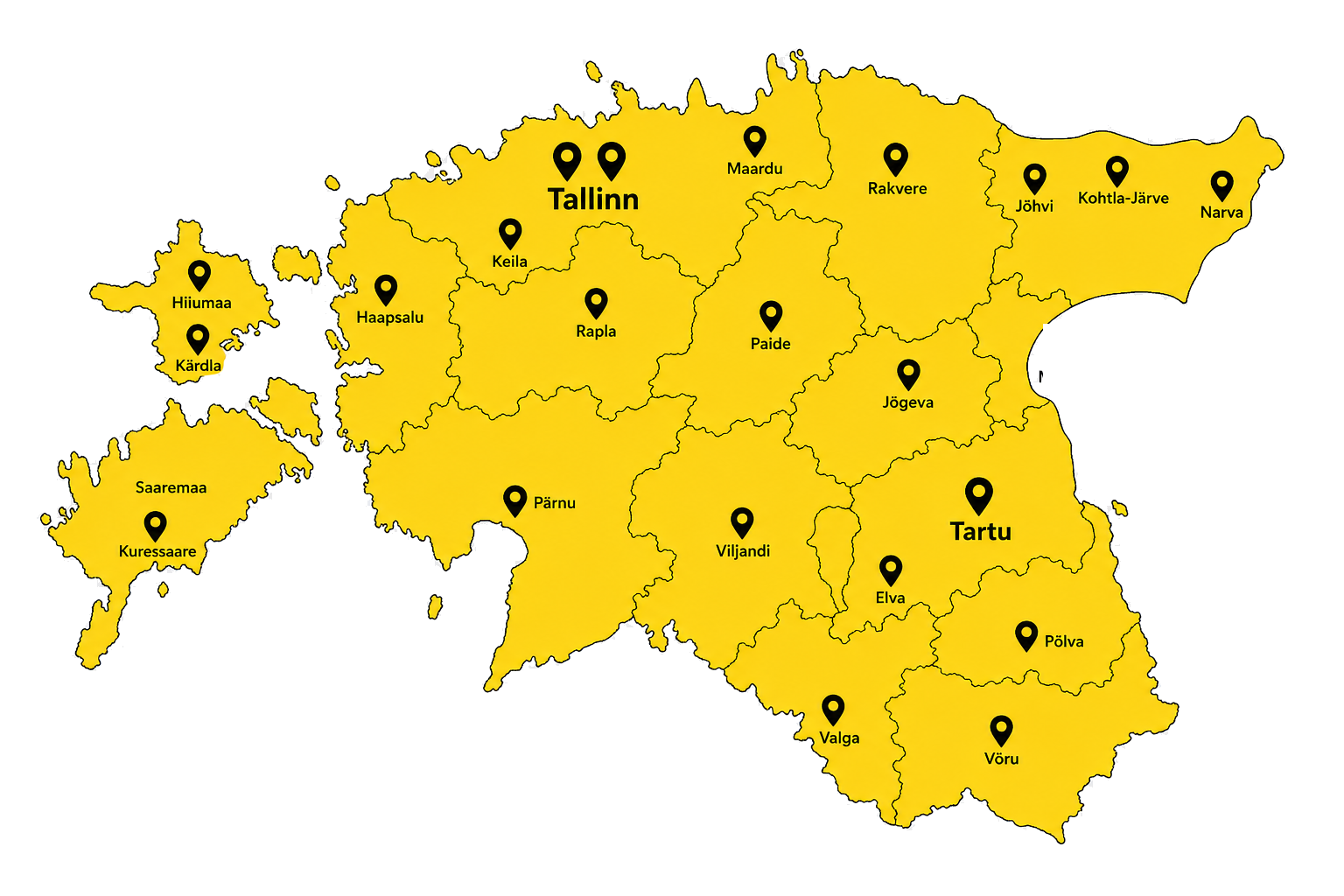
Our primary service area is Tallinn and Harjumaa, but we travel throughout Estonia. In Tallinn, an emergency team usually arrives within 30-60 minutes, and in Harjumaa within 1-2 hours.
Sõidame välja kogu Eestis. Avariitööd ööpäevaringselt, 7 päeva nädalas.