PE/PEM Pipe Butt Welding
Thermal butt welding of polyethylene pipes with hydraulic or mechanical welding equipment for diameters where a butt joint is technically and economically viable.
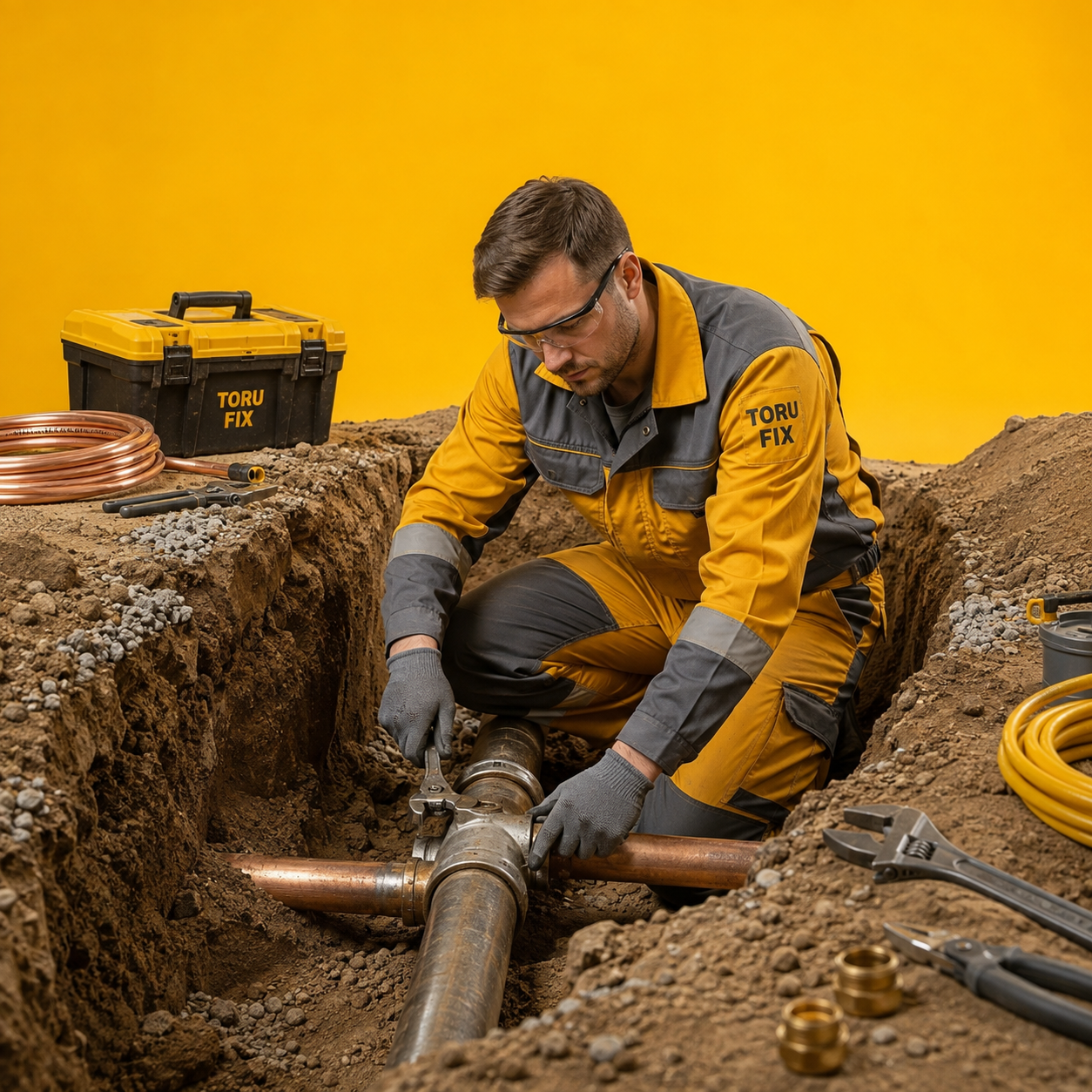
We offer PE/PEM pipe welding services in Tallinn and Harjumaa: polyethylene pipe butt welding with a welding machine, PE pipe electrofusion welding with couplers and saddle fittings, repair of existing pipelines, and connection of new water and pressure lines. Every weld is performed according to manufacturer parameters and documented with a protocol.
Thermal butt welding of polyethylene pipes with hydraulic or mechanical welding equipment for diameters where a butt joint is technically and economically viable.
Electrofusion coupler connections in trenches, confined spaces, and for repair work – precise welding time read from the fitting's barcode.
Installation of electrofusion saddles onto existing mains to create new branches, hydrants, or house connections.
Cutting out a damaged section and inserting a new pipe with electrofusion couplers, including rapid emergency repairs.
Connecting PE/PEM pressure pipelines to existing networks, transitions to cast iron, steel, and PVC with flange or transition fittings.
Pressure testing of pipelines, documentation of results, and handover of welding protocols and as-built data to the client.
Dispetšer vastab ööpäevaringselt. Peatame kahju leviku, lokaliseerime lekke ja sõidame välja ka öösel ning pühade ajal.
+372 58 024 476PE/PEM pipe welding is a method of joining polyethylene pipes where the pipe ends are heated to the material's melting temperature and pressed together, forming a joint as strong as the pipe itself. This is what distinguishes PE piping from most other solutions: a properly executed welded joint is not the weakest point but exactly as strong as the pipe itself. If you are looking for services under the keywords PE/PEM pipe welding, PE pipe welding, or polyethylene pipe joining, this page explains how the work is actually done, when butt welding is used versus electrofusion welding, what equipment is required, and what determines the cost of PE/PEM pipe welding.
In everyday Estonian, 'PEM' refers to polyethylene pipes operating under pressure – typically black or blue-striped PE100 or PE80 pipes used in potable water, fire water, pressure, and external utility lines. Such pipes should not be joined with ordinary couplings or adhesive: the only reliable permanent connections are thermal butt welding, electrofusion welding (also known as PE pipe coupler welding), and mechanical compression fittings. A welded joint is the only solution that can be buried without a maintenance chamber, as it requires no subsequent re-tightening.
ToruFix provides PE and PE/PEM pipe welding services in Tallinn and Harjumaa for both new line installations and repairs of existing pipelines. We work on projects ranging from private house connections to utility lines for cooperatives and businesses. Below, we discuss: where PE/PEM pipes are used, how butt welding and electrofusion welding technically differ, the step-by-step work process, how to prepare pipes, the necessary equipment and quality control, common mistakes, how existing pipelines are repaired, and what influences the cost.
ToruFix provides PE and PE/PEM pipe welding services in Tallinn and Harjumaa for both new line installations and repairs of existing pipelines. We work on projects ranging from private house connections to utility lines for cooperatives and businesses. Below, we discuss: where PE/PEM pipes are used, how butt welding and electrofusion welding technically differ, the step-by-step work process, how to prepare pipes, the necessary equipment and quality control, common mistakes, how existing pipelines are repaired, and what influences the cost.
PE/PEM pipe welding is a thermal joining process where polyethylene is brought to a plastic state, and the molecules of the two parts intermix. The result is not an adhesive or compression connection, but material continuity: after cooling, there is no separate boundary layer at the joint that could separate over time. This is why thermal welding of PE pipes is considered the only method that creates a truly monolithic pressure pipeline.
A peculiarity of polyethylene is that it does not tolerate improvisation. Melting temperature, heating time, jointing pressure, and cooling time are precisely defined by the manufacturer and depend on the pipe diameter, wall thickness, and SDR class. If any parameter is altered – for example, removing the pipe from pressure too early – a joint will form that looks sound externally but will fail with the first water hammer or ground movement. This is precisely why PE/PEM pipe welding is not a job that can be done with improvised means on a construction site.
Another important reason for choosing a welded connection is its long lifespan. PE100 pressure pipelines are designed to operate for decades, and the welded joint must last just as long. Mechanical fittings contain gaskets and metal parts that age and corrode underground faster than the plastic pipe itself. A welded joint contains neither gaskets nor metal, thus eliminating typical failure points.
Thirdly, welding allows the joint to be left in the trench without access. For a mechanical fitting, access should actually be provided for future inspection and tightening, which implies a manhole or access hatch. A welded PE line is covered with sand and forgotten for decades – a significant advantage in excavation logic, as it avoids creating points that require later re-excavation.
Polyethylene pipe is now the standard solution for external utility lines. Most commonly, we encounter it in potable water house connections: a single, continuous PE pipe runs from the connection point to the house, with its ends joined by welded fittings or transition couplings. Since the pipe comes in a coil, long sections can be installed without making any joints – every joint that isn't made is a potential failure point that won't occur.
Another major application is pressure sewerage. When wastewater needs to be pumped uphill or over a long distance, gravity-fed PVC piping is unsuitable, and PE pressure pipe is used, whose joints must withstand the pressure and pressure surges generated by the pump. In such a system, a welded connection is practically mandatory, as pump startup and shutdown stress the pipeline with every cycle.
Thirdly, PE pipes are used in drainage pressure pipelines, stormwater pumping, irrigation and process water systems, fire water pipelines, and as protective conduits into which smaller diameter pipes or cables are later pulled. In industry, polyethylene pipes are also used due to their chemical resistance – PE tolerates many environments that would corrode metal.
A fourth area is renovation. Old cast iron or steel pipelines can often be replaced by excavating only the beginning and end of the line, and pulling a new PE pipe inside the old one. This method requires that the entire pulled-in section is pre-welded into a single continuous pipe – this work cannot be done without butt welding.
Butt welding, or PE pipe butt welding, is a method where two pipe ends are pressed against a heating element, uniformly heated through, and then pressed directly together. The pipe ends must be absolutely parallel and on the same axis, as molten material does not correct geometric errors – on the contrary, any misalignment is amplified in the joint.
The process begins by clamping the pipes into the welding machine's jaws. Then, a planer shaves both ends clean in one motion, ensuring surfaces are fresh, smooth, and precisely opposed. After planning, the gap between the ends is measured: if a gap or misalignment exceeds the permitted limit, the clamping must be re-evaluated, as a good joint will not result from such a position.
Next, the heating element is placed between the pipes. Initially, higher pressure is applied to create a uniform initial bead around the entire circumference – this indicates full contact. Pressure is then reduced, and the soaking phase begins, during which heat penetrates deeper into the material. This stage is most often rushed, and it's where subsequent failures originate.
The heating element is quickly removed, and the pipes are pressed together with the prescribed force. From this point, the joint must not be moved: the welding machine maintains pressure throughout the cooling time, which for larger diameter pipes can be tens of minutes. Only after complete cooling can the pipe be released from the jaws and moved.
The finished joint is evaluated by its bead: it must be uniform around the entire circumference, symmetrical on both sides, and without sharp grooves. An uneven or missing bead on one side indicates that the pipes were not on the same axis or heating was uneven – such a joint is cut out and re-welded.
Butt welding is primarily suitable when pipes are welded on the surface, there is ample space, and many joints are required. For larger diameter pipelines, it is clearly the most economical solution, as no fittings are consumed – the pipe is joined directly to the pipe.
Butt welding is also the only reasonable way to pre-fabricate long sections before lowering them into a trench or pulling them into an old pipe. The line is welded together on the surface, inspected, and then installed.
Butt welding requires that both pipes can be moved and aligned in the machine. In a narrow trench, where one pipe end is fixed in the ground, this is usually not possible.
Also, butt welding cannot be used to join pipes of different wall thicknesses or different material grades – the melt flow index and wall thickness must be compatible, otherwise an uneven joint will result.
PE pipe electrofusion welding uses a fitting with an embedded resistance wire coil. The pipe ends are pushed into the coupler, and the welding machine directs current to the coil: the wire heats up, melts the inner surface of the coupler and the outer surface of the pipe, and the materials fuse. The pipe itself remains stationary – there are no moving parts, which makes the method significantly more practical in a trench.
All welding parameters are pre-defined by the fitting manufacturer and encoded on a barcode. The welding machine reads the code with a scanner, automatically sets voltage and time, and saves the protocol. This minimizes human error but does not replace preparation: the machine does not know if the pipe surface has been scraped and degreased.
The most crucial step is removing the outer surface of the pipe with a scraper. The surface of polyethylene has an oxidized layer that inhibits fusion – this must be removed along the entire length that enters the coupler, and only then should the surface be cleaned with a special PE cleaning fluid. Touching it with bare hands after cleaning will ruin the work, and this happens more often than one might expect.
Another critical requirement is checking for ovality. Pipes supplied in coils are not perfectly round and must be forced into a round shape within the coupler using re-rounding clamps. If the pipe remains oval, uniform contact will not occur around the coil, and part of the joint will remain cold. Clamps must remain on during the entire welding and cooling time.
Electrofusion welding is also used for saddle fittings when a new branch needs to be added to an existing line. The saddle is welded to the pipe, and only then is a through-hole drilled using an integrated cutter. In many cases, this allows for a new house connection without draining the main line.
The choice is not a matter of preference but determined by the project. Butt welding is advantageous where there are many joints, sufficient space, and similar pipes – for example, a long new water line welded together on the surface. No fittings are consumed, so material costs are lower, and welding speed per joint is higher.
Electrofusion welding is advantageous where pipes cannot be moved: in a trench, next to a wall, in a well, for repairing an existing line, and in situations where pipes of different wall thicknesses or batches need to be joined. It is also sensible when there are few joints, and bringing a large butt welding machine to the site is not practical.
In practice, we often use both methods on a single project. Straight sections of the line are butt welded on the surface, and after lowering into the trench, final connections and branches are made with electrofusion couplers. This saves on fittings where possible and maintains reliability where there is no room for maneuver.
If the pipeline is to be buried for a long time and later access is costly, we always prefer a welded joint over a mechanical fitting, regardless of the welding method chosen. Mechanical fittings are reserved for locations where a manhole already exists or where the connection is temporary.
We begin with site inspection. We review the line's location, existing pipelines, diameters, material, and SDR class, and assess whether the work can be done on the surface or only in a trench. This determines whether a butt welding machine, an electrofusion machine, or both will be needed, and how to plan for water interruptions.
The second stage is preparation: the trench is excavated and leveled with a sand bed, pipes are brought to the site and allowed to acclimate to the temperature, and materials are verified against the project. In winter and wet weather, a tent or shelter is erected over the welding area, as wind and moisture directly affect the heating process.
The third stage is welding using the chosen method, with immediate visual inspection after each joint. Each joint is marked and recorded in a protocol – on larger sites, joints are numbered on the line diagram to allow identification of specific joints if questions arise later.
The fourth stage is pressure testing. The pipeline is filled and pressurized to the specified level, held under pressure, and the result is documented. Only after a successful test is the line backfilled: first a layer of sand around and over the pipe, then layered backfill with compaction and warning tape installation.
The fifth stage is handover. We provide the client with welding protocols, pressure test results, and as-built data on the line's location. These documents are necessary for connecting to the utility company and later, if future excavation is planned on the property.
Most failed PE welds do not fail due to the welding equipment but due to inadequate preparation. The pipe must be clean, dry, and at the correct temperature. Dirt, sand, and moisture on the welding surface get trapped in the joint, creating areas where the material has not fused.
The pipe is always cut squarely with a specialized cutter, not a saw or angle grinder. A crooked cut results in uneven contact in butt welding and, in electrofusion, means the pipe does not extend deep enough into the coupler. Burrs from cutting are removed.
For electrofusion, the insertion depth of the coupler is measured and marked on the pipe surface, then the entire area is scraped with a special scraper. A sharp shaving must come off uniformly around the entire circumference – if any spot remains shiny, the oxidized layer has not been removed. Only after scraping is the surface cleaned with PE cleaning fluid and allowed to dry completely.
Pipes supplied in coils retain memory and tend to curve back. Therefore, the ends to be joined must be straightened and fixed so that no lateral stress is applied to the joint during welding and cooling. If the pipe pulls the joint askew during cooling, internal stresses will develop, which may only manifest months later.
Temperature is a separate issue. In cold weather, pipes and fittings must be kept warm until installation, the welding area covered, and a longer cooling time allowed. On a hot day, there is an opposite risk: direct sunlight heats the pipe more on one side, causing the material to behave unevenly during welding – which is why we shade the welding area even in summer.
A PE/PEM pipe welding machine consists of a frame with clamps, a hydraulic or mechanical pressure drive, a planning tool, and a heating element with a thermostat. Modern machines record the parameters of each joint: temperature, pressure, times, and operator. For electrofusion, the welding machine performs the same function, reading the fitting's barcode and recording the welding cycle.
The surface of the heating element must be clean and undamaged. Polyethylene residue accumulating on it alters heat transfer and compromises the next joint. We clean the element before each weld as prescribed and check the actual surface temperature with a separate thermometer, not just relying on the machine's display.
Quality control begins with visual assessment. The butt joint bead must be uniform, symmetrical, and of the correct width; electrofusion joint indicators must have protruded on both sides of the coupler. An indicator shows that the material has expanded but does not alone prove the integrity of the joint – therefore, we also check the pipe's position in the coupler and ensure the welding machine completed the cycle without error messages.
In case of doubt, a destructive test is performed: a sample joint welded with the same parameters is cut into strips and bent or torn apart. If failure occurs outside the joint, the parameters are correct; if the joint opens at the surface, the process must be reviewed. For critical projects, a sample joint is made at the beginning of the workday.
The final check is pressure testing. This is the only test that assesses the entire pipeline as a whole, including all joints. We record the test time, pressure, and result, and provide the protocol to the client – this is a document required by both the utility company and future property buyers.
The most common mistake is rushing the cooling phase. The joint feels strong immediately after welding, but the material is still plastic, and any movement creates internal stresses. Such joints often pass pressure tests and only leak months or years later, when the pipeline is already backfilled.
Another common mistake for electrofusion is an unscraped or improperly cleaned surface. The oxidized layer does not fuse properly, resulting in a partial joint. Touching the joint with bare hands after cleaning or using an arbitrary solvent instead of cleaning fluid leads to the same outcome.
A third mistake is butt welding pipes of different SDR classes or different materials. With pipes of different wall thicknesses, pressure is not distributed uniformly, creating a stepped weak point in the joint. In such cases, an electrofusion coupler or transition fitting must be used.
A fourth mistake is welding without weather protection. Wind cools the heated end unevenly, rain and snow reach the molten surface, and trench water completely ruins the joint. The trench must be dry – if necessary, water is pumped out and kept out throughout the welding process.
A fifth mistake is improper installation of the welded line in the trench. If the pipe is placed on a rocky surface, a sharp object, or without a sand bed, point loads are transferred to the pipe and joint. Thermal expansion of polyethylene must also be considered: the pipe is installed slightly undulating, not taut.
A sixth mistake is lack of documentation. Without welding protocols and as-built data, it is impossible to prove that the work was done correctly or to locate joints later. In case of a problem, this means excavating the entire line just to find one joint.
In water lines, PE pipe is the most common solution, from house connections to street mains. Potable water pipes are marked accordingly and should not be replaced with pipes for technical purposes. Welded joints are especially crucial here because the pipeline is constantly under pressure, and any leak means both water loss and soil erosion.
In pressure sewerage, the pipeline operates cyclically: the pump switches on and off, creating pressure changes and surges. Such stress will expose any weak joint. Furthermore, a pressure sewerage leak is significantly more unpleasant for the environment and property than a clean water leak, so the quality requirements for joints are higher.
PE pressure pipe is used more often than commonly thought for stormwater and drainage pumping. If water needs to be lifted from a collection well or directed away from a property, a gravity-fed solution is not feasible, and the pumped section must be a pressure-rated pipeline.
For external utility lines in general, PE's advantage is flexibility. The pipe tolerates ground settlement and movement that rigid cast iron or ceramic pipes cannot. In case of freezing, polyethylene pipes typically do not burst in the same way as rigid pipes, although this should not be taken as permission to leave the line above freezing depth.
In industry and technical systems, PE pipes are used for transporting process water, cooling water, and various fluids. Where pipelines pass through areas where mechanical fittings would be inaccessible or hazardous, welded PE is the only sensible choice.
The most common repair is fixing a pipe damaged during excavation. An excavator or shovel cuts the pipe, water starts flowing into the trench, and the line needs to be restored quickly. The process is always the same: depressurize, pump water out of the trench, cut out the damaged section squarely, prepare the ends, and weld in a new section with two electrofusion couplers.
If the damaged section is very short, a repair saddle or extension coupler is sometimes used. We decide on-site: it is important that the final solution withstands the same pressure as the rest of the pipeline and that it is not left stressed in the trench.
Creating a new branch on an existing line is done with an electrofusion saddle. The saddle is welded to the main pipe, and only then is the through-hole opened with an integrated cutter. This allows new house connections or hydrant branches to be made without cutting off the entire main line.
Often, PE pipe needs to be connected to another material – old steel, cast iron, or PVC. For this, transition fittings are used: a flange connection with a PE stub end, a threaded transition, or a mechanical compression fitting. Such locations are the only ones where we recommend providing access, as transitions between different materials are the most sensitive points of a pipeline.
Before repair, it is worth determining the actual cause of the failure. If the leak occurred due to ground settlement, improper installation, or rocky backfill, the same failure will recur elsewhere on the line. In such a case, in addition to repairing the joint, we propose relocating the problematic section – this is cheaper than new excavation work every spring.
The price of PE/PEM pipe welding is not a single number per joint, as making a joint of the same diameter can take fifteen minutes or half a day, depending on where and under what conditions it needs to be done. The biggest influencing factor is the pipe diameter and wall thickness: the thicker the pipe, the longer the heating and cooling time, and the more powerful equipment required.
The second factor is the welding method. Butt welding does not require fittings, so material cost is lower, but it requires space and bringing equipment to the site. Electrofusion is more expensive due to the fitting, but often the only option and faster in a trench. For a large number of joints, butt welding is usually more economical; for individual joints, electrofusion.
The third factor is access and working conditions. A clear site where pipes can be butt welded on the surface is fast. A narrow trench, a deep well, a wet worksite, a street under traffic, or winter weather require extra time, weather protection, and often a pump or shoring.
The fourth factor is associated works. Often, the client doesn't just need welding but a complete solution: excavation, sand bedding, pipe installation, connection to the existing network, pressure testing, and restoration. If these tasks are handled by a single contractor, the total cost is usually lower, and accountability is clearer than when divided among multiple parties.
The fifth factor is speed. Planned work that can be scheduled is more economical than an emergency call-out in the evening or on a weekend. For emergency work, the price is higher, but with stagnant water or a broken pressure pipeline, speed is usually more important than the tariff difference.
We provide a quote after site inspection or based on sufficiently precise information: pipe diameter, material, number of joints, location, and whether excavation has already been done. This prevents situations where the initial estimate and final bill differ significantly.
We provide both welding and excavation/piping services, so the client doesn't have to coordinate multiple contractors. The same team prepares the trench, welds the line, connects it to the existing system, pressure tests, and restores the ground – accountability is consolidated.
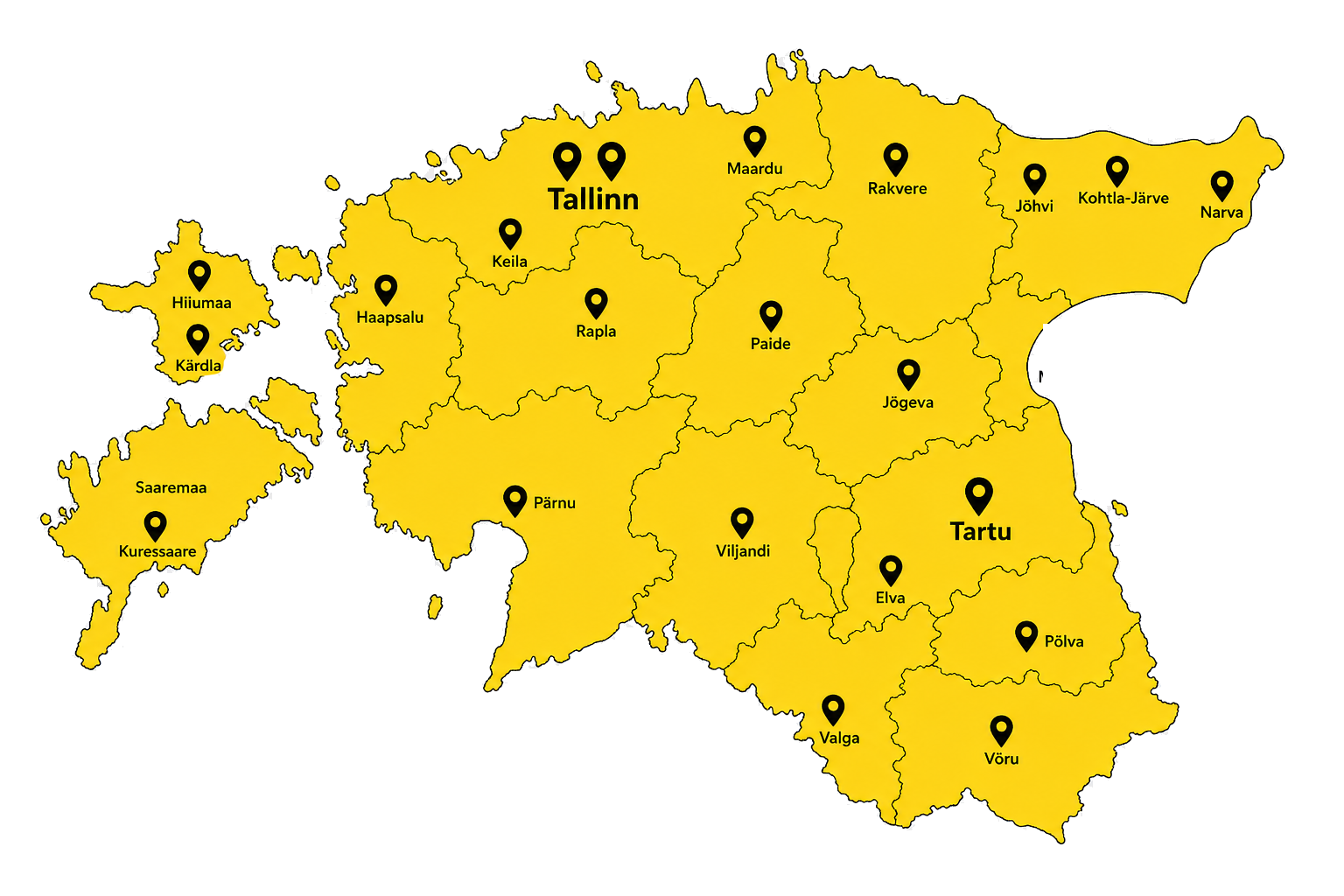
We operate in Tallinn and Harjumaa and travel further by agreement. In emergency situations – for example, if a pressure pipe is broken during excavation – we respond 24/7, because waiting for such a fault means water loss and soil erosion.
Every joint is documented, and the pipeline is handed over with pressure test results. This is important for connection to the utility company, for building documentation, and for any future property transactions.
We also tell you when welding is not the best solution. Sometimes it's more sensible to use a mechanical fitting in a well or replace an entire section rather than repeatedly repairing the same problematic spot. Our goal is a pipeline that works for decades, not the fastest possible invoice.
Oleme 24/7/365 kõikjal Tallinnas ja Harjumaal.
Tuleme kohale kiiresti ja lahendame probleemi kohapeal.
Teeme tööd korrektselt ja anname garantii.
Selge hinnainfo enne tööde algust, üllatusi ei tule.
Aitame vormistada kahjujuhtumeid kindlustusseltsidele.
Helista või kirjuta – kirjelda probleemi paari lausega.
Ütleme tunnihinna ja eeldatava mahu enne kohalesõitu.
Tallinnas tavaliselt 30–60 minutiga, oma tehnika ja varuosadega.
Teeme töö, kontrollime süsteemi ja anname garantii.
Installation of new water and sewerage lines, including excavation and connections.
external utility line constructionFull range of plumbing services: pipeline repair, replacement, risers, and pressure testing.
plumbing servicesReplacement of old water pipes and connection of indoor plumbing to external lines.
water pipe replacementLocating leaks in pressure pipelines before excavation.
leak detectionCamera inspection of existing pipelines and manholes before work begins.
video inspection24/7 assistance when a pressure pipe is broken or a line is leaking.
pipe emergencyPE/PEM pipe welding is the thermal joining of polyethylene pipes, where the pipe material is melted and pressed together so that the joint becomes as strong as the pipe itself. Two methods are used: butt welding and electrofusion welding, also known as coupler welding.
In butt welding, pipe ends are heated with a heating element and pressed directly together – no fitting is used. Electrofusion welding uses a coupler with a resistance wire, which heats up due to current and fuses the pipe to the coupler. Butt welding is suitable for working on the surface, while electrofusion is for trenches and confined spaces.
Technically, mechanical compression fittings can be used, but these contain gaskets and metal parts that age underground. For buried pressure pipelines, a welded joint is significantly more reliable and does not require a maintenance manhole.
This depends on the diameter and wall thickness. Electrofusion of a smaller pipe, including preparation and cooling, typically takes half an hour to an hour. A larger diameter butt joint takes significantly longer, as the cooling time must not be shortened.
Yes, but the welding area must be protected from wind and precipitation, pipes and fittings kept warm before installation, and a longer cooling time allowed. Welding in a wet or frozen trench is not permitted – water must be pumped out beforehand.
Pipes of different diameters are joined using a transition fitting or reducer. For pipes of different wall thicknesses or SDR classes, we use an electrofusion coupler instead of butt welding, as the butt joint would be uneven.
Each joint is visually inspected – for butt joints, the uniformity and symmetry of the bead; for electrofusion couplers, the indicators and completion of the cycle without error messages. Welding parameters are recorded in a protocol, and the pipeline is pressure tested before backfilling. If necessary, a destructive test of a sample joint is performed.
Yes, this is one of our most frequent jobs. We cut out the damaged section and weld in a new pipe with two electrofusion couplers. In emergency situations, we respond 24/7.
Yes, for this we use an electrofusion saddle fitting, which is welded to the main pipe, and only then is the through-hole opened. In many cases, the work can be done without replacing the entire main line.
The main factors are pipe diameter and wall thickness, number of joints, chosen welding method, access and working conditions, and whether only welding or a complete solution including excavation, pressure testing, and restoration is ordered. We provide a quote after site inspection.
Yes. We hand over welding protocols, pressure test results, and as-built data for the pipeline. These documents are necessary for connecting to the utility company and for planning future excavation.
Yes. Our emergency service operates 24/7/365, including public holidays. Night and holiday call-outs are tariffed higher than weekday visits, but for a broken pressure pipeline, swift intervention is almost always cheaper than waiting.
Our primary service area is Tallinn and Harjumaa, but we travel elsewhere in Estonia by agreement.
Sõidame välja kogu Eestis. Avariitööd ööpäevaringselt, 7 päeva nädalas.