Site Selection and Preliminary Works
Plot inspection, assessment of soil and groundwater levels, boundary checks, and determination of septic tank and infiltration system location.

We offer turnkey septic tank and bio-purifier installations: we assess soil and groundwater conditions, select the appropriate tank and infiltration solution, perform excavation, connect the system to the house drainage, and provide a warranty for the installation. We operate in Tallinn and throughout Harjumaa.
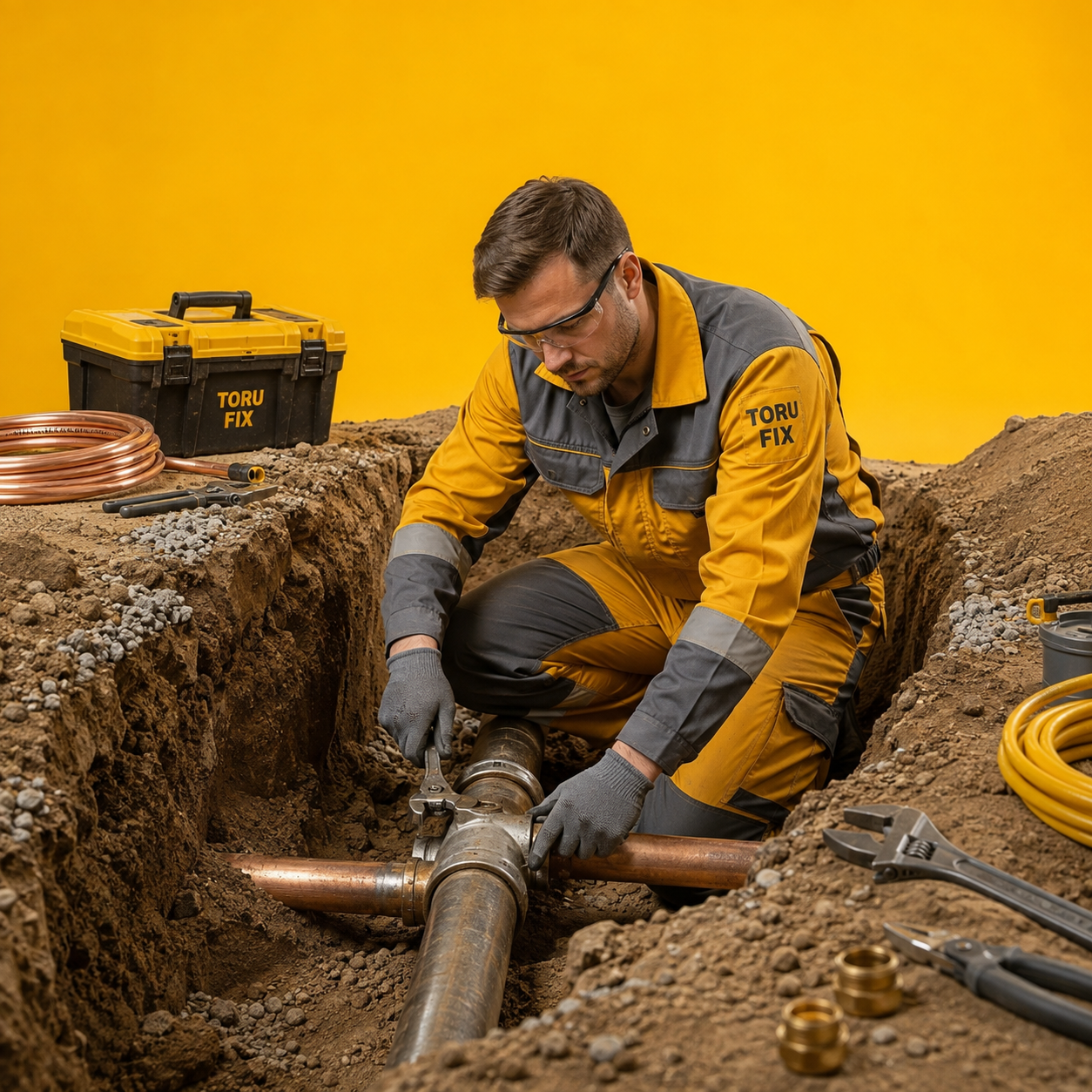
Plot inspection, assessment of soil and groundwater levels, boundary checks, and determination of septic tank and infiltration system location.
Pit excavation, sand bed or concrete slab, tank anchoring, and proper backfilling.
Installation of septic tank, bio-purifier, or holding tank with soakaway field, infiltration tunnel, or filter cassette.
Connecting the house outlet pipe, ventilation, inspection chambers and access points, system check, and user instruction.
Dispetšer vastab ööpäevaringselt. Peatame kahju leviku, lokaliseerime lekke ja sõidame välja ka öösel ning pühade ajal.
+372 58 024 476Septic tank installation is one of the few construction works where the result is not easy to change later. Once the tank is buried, the soakaway field covered, and landscaping restored, correcting a wrong location, incorrect volume, or unsuitable infiltration solution practically means doing the same job twice. This is precisely why proper septic tank installation begins not with excavation, but with assessing the actual needs of the plot and household.
ToruFix OÜ installs septic tanks, bio-purifiers, and holding tanks for detached houses, summer homes, terraced houses, and small commercial properties in Tallinn and Harjumaa. We provide turnkey services: we assess the situation on-site, propose a suitable solution, carry out excavation, install the tank and infiltration system, connect it to the house's drainage, and offer a warranty for the installation work.
This page explains in detail the differences between a septic tank, a bio-purifier, and a holding tank, how volume and location are chosen, what the actual installation process involves step-by-step, which mistakes are the most costly, and how to keep an on-site treatment system operational for decades. We also describe what makes plots in and around Tallinn and Harjumaa different from elsewhere in Estonia.
An on-site treatment system is needed when a building cannot or should not be connected to the public sewage system. In Harjumaa, this situation is common: new residential areas grow faster than the pipe network, and many older villages and summer cottage areas are not connected to the public network at all. In such cases, a septic tank or bio-purifier is the only way to properly treat household wastewater.
Another common situation is replacing an existing system. Old concrete ring holding tanks and homemade infiltration systems have largely reached the end of their lifespan: ring joints leak, covers have broken, soakaway fields are clogged, and wastewater reaches the soil untreated. If the emptying lorry needs to come every couple of weeks, this is not normal on-site treatment, but a continuous and expensive emergency solution.
A third situation is new construction. For a new house, the drainage solution is planned immediately along with the foundation and utilities. Here, it is easiest to do everything correctly the first time: the outlet pipe gets the correct slope, the tank the correct depth, and the soakaway field sufficient distance from the drinking water well.
The three most common on-site treatment solutions solve the same problem in different ways and have very different operating costs. A septic tank is a multi-chamber settling tank where wastewater settles and undergoes pre-treatment, after which the partially treated water is directed to an infiltration system where the soil performs the final purification. A septic tank itself is not a final purifier – it only works in conjunction with a soakaway field, infiltration tunnels, or a filter cassette.
A bio-purifier is an active system where wastewater is biologically treated using aeration. The unit requires electricity and regular maintenance but cleans the water significantly better, meaning the infiltration solution can be smaller, or in some cases, the effluent can be directed to a ditch or infiltration well. A bio-purifier is especially suitable where the plot is small, the soil has poor permeability, or groundwater is high.
A holding tank does not purify anything – it collects all wastewater and is emptied regularly by a sewage lorry. This solution is the cheapest to install but the most expensive to use, as every cubic metre of water must be transported away. A holding tank is sensible where infiltration is not permitted or possible: a very small plot, a protected area, high groundwater, or a seasonal summer house with low load.
In practice, we choose a solution based on three factors: how much wastewater is generated, the soil and groundwater conditions, and any restrictions applicable to the specific plot. If two solutions seem equal, we also calculate the ten-year operating cost – often, a more expensive unit turns out to be cheaper in the long run.
The choice of volume is based on the number of residents in the household and actual water consumption. As a rule, approximately 100–150 litres of wastewater per person per day are accounted for, and the septic tank's volume must ensure that water has enough time to settle in the chambers. A tank that is too small means that sludge reaches the soakaway field and ruins it within a few years.
A tank that is too large is also not automatically a better choice. With a very low load, the biological process may not start properly, plus a larger tank costs more and requires a deeper excavation. Therefore, we choose the volume based on the actual, not theoretical, maximum load.
Peak load must be considered separately. If the family has a washing machine, dishwasher, and hot tub, and guests visit often, the instantaneous flow rate is significantly higher than usual. In such cases, we account for a reserve in volume selection or add a balancing tank to prevent the system from receiving shocks that would disturb the sludge layer.
For a summer house, the opposite logic applies: usage is seasonal, and the system stands idle in winter. In this case, it is important to choose a solution that tolerates downtime and restarts in spring without problems – this is one reason why the same bio-purifier suitable for a year-round home is not always appropriate for a small summer house.
The most critical technical question in septic tank installation is not the tank itself, but where the water exiting it goes. If the soil is sandy and highly permeable, and groundwater is deep, a classic soakaway field can be used: perforated piping on a gravel bed, through which water is evenly distributed into the soil.
In clayey soil, a soakaway field simply won't work – the water won't drain and will eventually surface. In such cases, a filter cassette or sand filter, partially built above ground, is used, or a bio-purifier is chosen, whose effluent is already clean enough to be directed to a more compact infiltration solution.
High groundwater is common in Harjumaa. If water stands half a metre deep in spring, the infiltration solution must be built elevated, as a soil layer must remain between the infiltration system and groundwater to perform the actual purification. Also, the tank must be properly anchored in such soil, otherwise an empty plastic tank can literally surface in spring.
Before choosing a solution, we inspect the plot on-site: if necessary, we dig a test pit, assess soil composition and moisture, and verify the locations of drinking water wells, plot boundaries, and buildings. A quote made without this information is always an assumption.
The septic tank location is not a free choice. Distances from drinking water wells, plot boundaries, buildings, and neighbours' wells, as well as local authority regulations, must be considered. Precise clearances depend on the area and the solution, so we always check them against the specific local authority's current regulations before starting work – a system installed according to generalised internet numbers may turn out to be non-compliant.
In addition to regulations, purely practical matters are important. The tank must be accessible to the emptying lorry: the hose does not extend indefinitely, and the vehicle won't drive through soft turf. The septic tank should not be placed on a driveway if the tank is not designed to withstand traffic loads. The soakaway field must not be located under dense landscaping, trees, or parking areas, as roots will clog the piping and compacted soil will not allow water to pass through.
It is also worth thinking about the future. If an extension, garage, swimming pool, or new driveway is planned, the septic tank and soakaway field must be positioned so that they do not fall under subsequent construction. One day of planning here often saves a costly rebuild amounting to several thousands of euros.
Every site is different, but a proper installation always follows the same logic. The first step is inspection and solution selection: we survey the plot, verify the depth and location of the house's outlet pipe, assess the soil, and agree on the type of tank and infiltration solution. Based on this, we prepare a quotation, clearly itemising the tank, materials, excavation, and installation work.
The second step is excavation. The pit is dug according to the tank's dimensions and required depth, considering the slope of the connecting pipe. The bottom of the pit is levelled, and a sand bed is created, or – in cases of high groundwater and heavy soil – a concrete slab to which the tank is anchored.
The third step is tank installation and connection. The tank is placed level, connected to the house's drainage outlet pipe, and from there to the infiltration system. Ventilation, necessary inspection chambers, and access points are installed, and for a bio-purifier, electrical supply and a compressor.
The fourth step is the construction of the infiltration system: soakaway field piping on a gravel bed, infiltration tunnels, or a filter cassette with geotextile and sand layers. Incorrect layer order is one of the most common reasons why a soakaway field stops working within a couple of years.
The fifth step is filling, inspection, and handover. The tank is filled with water simultaneously with backfilling – this prevents tank deformation. We check flow-through, connection tightness, and system operation, and explain to the owner how the system works, how often to empty it, and what not to flush down.
A large portion of our septic tank installation work is not for new builds, but for replacing old solutions. A typical situation is a concrete ring well built in the 1970s–1990s, lacking a sealed bottom and with open joints. Such a well is not a septic tank, but essentially a leaking holding well, whose contents reach the soil uncontrollably.
During replacement, a decision must be made about what to do with the old structure. Some rings can be used as an inspection or pump well if their condition allows. If the rings are cracked, they must be excavated and removed, and the pit properly filled. Leaving an old tank in the ground without emptying and filling it is dangerous – the cover can collapse over time.
The advantage of replacement is that the pipeline between the house and the tank usually already exists. Often, an inspection and partial upgrade are sufficient, which saves on excavation volume. However, if the old pipe has sagged or is made of unsuitable material, it is sensible to replace it at the same time – excavating the yard a second time is many times more expensive.
A septic tank is not a device that can be installed and forgotten. The most important maintenance task is regular emptying. The rate of sludge accumulation depends on the size of the household and the tank, but in most homes, this means emptying at least once a year. If too much sludge accumulates, it transfers to the infiltration system and clogs it – and restoring a soakaway field is many times more expensive than timely emptying.
Another important thing is what goes down the drain. Wet wipes, hygiene products, cat litter, construction mix, and grease are the main killers of on-site treatment systems. Grease cools in the pipework and chamber, binds other debris, and forms a layer that gradually blocks the flow. In a biological system, large amounts of chlorine-based cleaning products also harm the bacterial community.
Thirdly, it is worth inspecting the system once a year: check the condition of covers and ventilation, water levels in the chambers, the state of the soil in the soakaway field, and for a bio-purifier, the operation of the compressor and aerator. Most serious failures give warning signs beforehand – an unusual smell, slowed drainage, or a wet patch above the soakaway field.
If drainage has already slowed or the pipework clogs repeatedly, the problem is not always in the septic tank. Often, the cause is the internal house pipework or connecting pipe, in which case drainage cleaning or blockage removal helps. This is why we start with diagnosis, not immediate excavation.
The first and most common mistake is underestimating the infiltration solution. A good tank is purchased, but the soakaway field is made too small, with incorrect materials, or in unsuitable soil. The system works for the first few seasons, then water starts to surface. The fix usually means rebuilding the entire soakaway field.
A second mistake is an incorrect slope on the pipe between the house and the tank. Too little slope leaves solids stagnant in the pipe, too much allows liquid to drain away and leaves solids behind – in both cases, the result is repeated blockages. A third mistake is the lack of ventilation: without proper ventilation, odour problems arise, and siphons empty.
A fourth mistake is not anchoring the tank in high groundwater conditions. A fifth is backfilling with incorrect material – stony soil presses against the tank wall and can deform it. A sixth mistake is installation without inspection and access possibilities, which turns every subsequent maintenance task into excavation.
One of the most frequent reasons why a properly installed septic tank is still overloaded is the routing of stormwater into the same system. Roof downpipes, driveway grates, or drainage are conveniently connected to the existing sewage system – and one good rainstorm sends several cubic metres of water into the septic tank in a couple of hours.
The consequence is twofold. Firstly, a large flow rate washes up the sludge layer and sends it into the soakaway field. Secondly, the water does not have time to settle in the chambers, resulting in significantly more contaminated water reaching the soil. Over time, this means both clogging of the soakaway field and an environmental problem.
The correct solution is to keep stormwater and wastewater in separate systems: roof and surface water are directed to an infiltration well, ditch, or stormwater system, while domestic wastewater goes to the septic tank. If these systems are mixed in an old household, they can be separated during installation – this is usually a small additional task whose cost-effectiveness is very quick.
We work with both private clients and legal entities, adapting the process according to the specific property.
In a year-round detached house, the load is consistent, and the system must work in all weather conditions. Here, the correct volume, a proper infiltration solution, and a tank location accessible to the emptying lorry even in winter are crucial. For a terraced house, the question arises whether each unit gets its own solution or if a shared, larger-capacity system is built – the latter is usually technically superior but requires a clear agreement among owners.
In a summer house, the system stands empty for part of the year. We choose a solution that tolerates downtime and cold and does not require a constant electrical supply if the property is used infrequently. For smaller loads, a simpler septic tank with an infiltration system is often more sensible than a more sensitive active purifier.
For a new house, we plan the drainage solution along with the rest of the external pipework. This ensures the outlet pipe has the correct depth and slope, excavation is done in one go, and landscaping doesn't need to be destroyed later. For new builds, we coordinate the work schedule with the construction timeline so that the septic tank is ready before the building is commissioned.
Small-scale production, workshops, offices, or rural service buildings differ from residential homes in the nature of their load: water is used in peaks during the workday. Here, we consider the need for a balancing tank and schedule work to minimise disruption to the property's operations.
Within Tallinn, on-site treatment is primarily necessary in suburban residential areas and garden associations where the public network has not yet reached. Plots there are often small and neighbours close, making the issue of clearances and access more important than the tank's price. In these cases, a bio-purifier or a compact septic tank with a filter cassette often proves to be the best solution.
Harjumaa is much more diverse in terms of solutions. In the direction of Harku, Saue, and Saku, the soil is sometimes clayey and groundwater high, which means an elevated infiltration solution. In Viimsi and coastal areas, groundwater protection and restrictions must be considered. For larger plots in the Kose, Kiili, and Anija regions, a classic soakaway field is more often possible due to ample space and suitable soil.
We travel from Tallinn throughout Harjumaa and, by agreement, further afield. For projects involving excavation, we schedule in advance, as the work depends on weather and soil conditions – the spring thaw period and prolonged autumn rain affect both excavation work and the quality of backfill.
Establishing an on-site treatment system is not just technical work. Depending on the local authority and plot location, a building notice or project design may be required, and a usage notice for the completed system. Requirements vary significantly by region, so during the initial inspection, we clarify which procedure applies to the specific plot and account for it when planning the work schedule.
Our role is to ensure that the installed solution complies with the project or notice, and that the owner has all necessary information after the work: tank and equipment documentation, warranty terms, installation diagram with tank and infiltration system location, and maintenance instructions. The diagram is especially important for the future – without it, any subsequent excavation or landscaping project must be done based on assumptions.
During handover, we review the system with the owner: we show where the covers and inspection access points are located, how to check water levels, how the system behaves after a longer absence, and when to order emptying. For a bio-purifier, we also explain compressor operation, signs of alarm situations, and what to do in case of a power outage.
The cost of septic tank installation consists of four parts: tank and equipment, infiltration system materials, excavation work, and installation labour. Of these, the excavation part varies the most, as it depends on the soil, depth, access, and how much soil needs to be removed from the site.
The price is also affected by the type of solution chosen. A classic septic tank with a soakaway field is usually cheaper to acquire than a bio-purifier but requires more space and suitable soil. A bio-purifier is more expensive and requires electricity and maintenance but allows for a more compact solution. A holding tank is the cheapest to install, but its operating cost increases with every emptying.
We do not quote a price before we have seen the site or received sufficiently precise information, as a number quoted from afar is inevitably an assumption. In the quotation, we itemise the costs separately to clearly show what exactly is being paid for and where savings can be made without sacrificing quality.
Our daily work is not just excavation, but the entire building's water and drainage system: pipework construction, blockage removal, high-pressure jetting, video inspection, and emergency works. This means we see every day what happens with improperly installed systems after a few years – and we avoid the same mistakes in new installations.
Before quoting, we inspect the site and explain why we recommend a particular solution. If a cheaper option is technically suitable, we say so honestly; if it's not, we explain the specific reasons, not generalities. Upon completion of work, we provide a warranty for the installation and issue a proper invoice suitable for submission to an apartment association or insurance company.
On-site treatment system installation is a collaboration: the owner knows their plot's history and future plans, we know how the system actually behaves. Combining this information yields a solution that works for decades, not just a season.
Oleme 24/7/365 kõikjal Tallinnas ja Harjumaal.
Tuleme kohale kiiresti ja lahendame probleemi kohapeal.
Teeme tööd korrektselt ja anname garantii.
Selge hinnainfo enne tööde algust, üllatusi ei tule.
Aitame vormistada kahjujuhtumeid kindlustusseltsidele.
Helista või kirjuta – kirjelda probleemi paari lausega.
Ütleme tunnihinna ja eeldatava mahu enne kohalesõitu.
Tallinnas tavaliselt 30–60 minutiga, oma tehnika ja varuosadega.
Teeme töö, kontrollime süsteemi ja anname garantii.
Scheduled pipework cleaning keeps the septic tank and soakaway field load within limits.
drainage cleaningTank emptying and external pipework high-pressure jetting in Tallinn and Harjumaa.
high-pressure jetting and sewage pumpingCamera inspection shows the actual condition of the pipework before or after installation.
video inspectionReplacement of the pipework between the house and the tank, and internal pipework.
drainage pipe replacementInstallation of a typical domestic septic tank, including excavation and infiltration solution, usually takes one to three working days, provided there is access and the soil presents no surprises. For larger volumes, heavy soil, or extensive pipeline replacement, the work may take longer.
A septic tank is a settling tank that pre-treats wastewater and requires a soakaway field or filter cassette for final purification by the soil. A bio-purifier actively cleans water biologically, requires electricity and maintenance, but produces cleaner effluent and needs a smaller infiltration solution.
The septic tank itself is suitable, but a classic soakaway field will not work in clayey soil. In such cases, we use a filter cassette, sand filter, or an elevated infiltration solution, or recommend a bio-purifier whose effluent requires less soil purification capacity.
In most homes, at least once a year, but the exact frequency depends on the tank and family size. If emptying is required significantly more often, it usually indicates an undersized tank, a leak, or that stormwater is being directed into the system.
Installation is possible even in cold weather, but frozen ground makes excavation slower and more expensive, and backfilling requires more attention. If the work is not urgent, we recommend planning it for a thaw period.
The distance depends on local regulations, the location of the drinking water well, plot boundaries, and the chosen solution. We check the applicable clearances according to the specific local authority's regulations and select a location that meets requirements and is accessible to the emptying lorry.
Sometimes it can: if the rings are intact, they are suitable for use as an inspection or pump well. If the joints leak or the concrete is cracked, the rings must be excavated and removed, and the pit properly filled.
Wet wipes, hygiene products, cat litter, cooking grease, paint, solvents, construction mix, and large quantities of chlorine-based cleaning products. These either clog the system or destroy the biological process.
We perform excavation, tank installation, infiltration system construction, and connections as a single job. The client does not need to coordinate multiple contractors, and responsibility for the outcome rests with one provider.
First, we identify the cause: whether the problem is septic tank overload, sludge transfer to the soakaway field, stormwater entering the system, or the age of the soakaway field. Some cases are resolved with cleaning and system overhaul; in case of extensive clogging, the soakaway field must be rebuilt.
Excavation affects the area of the tank, infiltration system, and connecting pipework. We plan the route to minimise disturbance to landscaping and paved surfaces and restore the ground after the work. Expectations regarding the extent of disruption are agreed upon before starting.
Yes, we provide a warranty for both the installation work and the materials we supply. Tanks and equipment also come with a manufacturer's warranty, whose terms are handed over with the documentation.
Yes. We perform maintenance, cleaning, and diagnostics for septic tanks and drainage systems even after installation and can arrange a regular inspection schedule.
Sõidame välja kogu Eestis. Avariitööd ööpäevaringselt, 7 päeva nädalas.