Drainage Pipe Video Inspection
Filming the interior of pipework with a colour digital camera in apartments, private houses, apartment buildings, and commercial properties – both risers and horizontal sections.

We inspect drainage, stormwater, and sewer pipes with a colour pipe camera: we find the true cause of blockages, collapsed and broken sections, incorrect gradients, loose joints, root ingress, and hidden leaks. The client receives a video recording and an overview with recommendations, allowing them to decide if cleaning is sufficient or if repairs are needed – without blind demolition.
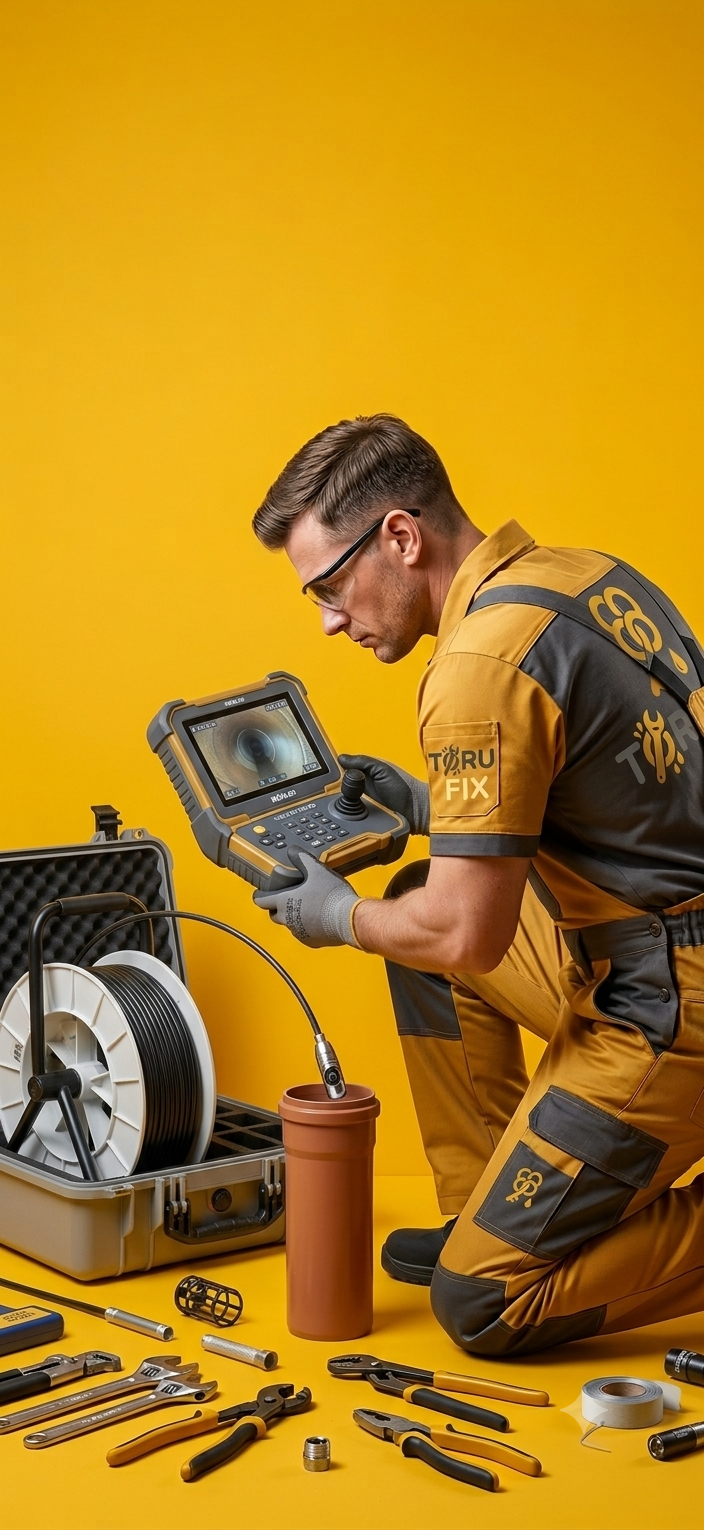
Filming the interior of pipework with a colour digital camera in apartments, private houses, apartment buildings, and commercial properties – both risers and horizontal sections.
Identifying pipe leaks, causes of blockages, transverse and longitudinal gradients, pipe sagging, cracks, and loose joints, and pinpointing their exact location.
Video inspection of underground lines, connection and inspection manholes, stormwater systems, and drainage pipework.
Using a camera sonde, we determine the location and depth of a defect on the ground, ensuring excavation work is precise and minimal.
Pre-purchase pipework inspection for property and acceptance inspection of new pipework before backfilling trenches or pouring concrete floors.
Video clip recording, an overview of the pipework's condition, and prescriptions and recommendations suitable for presentation at apartment association meetings or to insurance companies.
Dispetšer vastab ööpäevaringselt. Peatame kahju leviku, lokaliseerime lekke ja sõidame välja ka öösel ning pühade ajal.
+372 58 024 476Video inspection, also known as video analysis or pipe camera survey, is a service that helps identify potential faults and problems in drainage pipes, both in old and new/modern installations. The video survey can identify pipe leaks, causes of blockages, transverse and longitudinal gradients, pipe sagging, or other defects in pipework and manholes.
By inspecting the drainage pipework, it's possible to assess its condition. Once a problem is identified, all potential faults and defects can be rectified before the situation deteriorates further.
The greatest value of a camera survey is financial. Without a survey, decisions are often based on assumptions: excavating the wrong spot, demolishing a tiled wall where no fault exists, or repeatedly jetting a section where the real issue is a collapsed pipe. A survey costs a fraction of these works and provides a definitive answer.
ToruFix OÜ conducts video inspections in Tallinn and Harjumaa for private clients, apartment associations, property managers, and construction companies. On this page, we explain what a camera sees and doesn't see, when to order a survey, how the work proceeds, how to read the report, and what decisions are reasonable to make based on it.
During a video inspection, the interior of the pipework is filmed, and a video clip is recorded. Based on this, an overview/report of the pipework can be compiled, and prescriptions and recommendations can be provided.
For a more effective outcome, we recommend cleaning the drainage pipework, i.e., ordering high-pressure jetting, before the camera survey. A clean pipe allows for better observation, identification, and documentation of risks, faults, and damage. Our experienced and qualified specialists are always ready to assist you.
Technically, the equipment consists of a flexible rod or cable reel, an illuminated camera head at the end, and a monitor that displays the image in real-time. The camera is inserted into the pipe via an inspection opening, a toilet drain, a manhole, or a disassembled connection. It moves through the pipework, recording the entire journey. A metre counter indicates the distance of the defect from the entry point – this figure is the most crucial information for subsequent repairs.
The diameter determines the choice of camera head. A small head fits into 32–50 mm basin and appliance connections, a medium one into 50–110 mm risers and apartment outlets, and a larger, self-propelled head into 110–315 mm external lines and collectors. Often, two sets are used on one site, as apartment interiors and outdoor areas present different challenges.
Often, situations arise where pipe damage is invisible to the naked eye, and, for example, the source of a leak is unknown and impossible to identify without extensive demolition. In such cases, a pipe camera survey comes to the rescue, as it not only identifies faults and problems but also precisely locates damage in internal and external building pipework, as well as buried mains and underground pipework.
Most findings fall into four categories: sediment, structural damage, construction defect, and foreign objects. Differentiating between them is the whole point of the survey, as each category requires a completely different solution and the cost varies by orders of magnitude.
Honest diagnostics also mean stating the limitations. The camera shows the inside of the pipe, not what is happening behind the pipe in the ground or structure. If a joint is loose and water is seeping out, we see the loose joint, but not the extent of the washout area created.
Pressurised water pipes are not inspected with a camera – they are filled with water and operate under pressure. Leaks in pressurised pipework are detected with thermal cameras, acoustic detection, and pressure testing; this is a separate service, which you can find on the leak detection page.
The camera cannot move through a completely blocked pipe or dense water. If the pipe is full, flow must first be restored by rodding or high-pressure jetting, otherwise the image will be blurry, and half the journey will be missed. The same applies to thick layers of grease – a crack behind the wall will be obscured by the grease.
And finally: the camera itself does not say who is responsible for the damage. It provides evidence – a recording, metre reading, and location – on the basis of which a technical conclusion can be drawn. The allocation of responsibility between the apartment owner, apartment association, and utility company arises from system boundaries and contracts.
In an apartment, a typical cause is a recurring slow drain or an odour. The camera enters from a sink connection, floor drain, or WC outlet and travels through the outlet to the common riser. Very often, it turns out that the problem is not in the apartment but in the riser or a wrongly constructed connection in a neighbouring apartment – this knowledge immediately changes whose responsibility it is to order repairs.
In apartment buildings and apartment associations, an inspection is mostly a decision-making tool. When discussion revolves around whether risers need cleaning or replacement, a camera-based overview provides an objective basis. For apartment associations, we prepare material suitable for presentation at general meetings: findings with metre readings, floor, and recommended priority.
In private houses, the most frequent object is the external line leading from the house to a manhole, septic tank, or public network. Here, the camera is often the only reasonable way to decide whether to excavate or not. The location and depth determined by the sonde mean that one accurate hole is dug, not three based on assumptions.
In commercial premises – catering, retail, manufacturing – inspection is part of maintenance. Pipework after grease traps, kitchen outlets, and car park stormwater systems are routinely checked, as downtime during working hours is exponentially more expensive than preventative checks outside opening hours.
When purchasing property, the roof, electrics, and moisture damage are inspected, but drainage usually goes unchecked – until the first blockage after moving in. However, an old private house's external line or a 1960s cast-iron riser is precisely the part that costs the most to repair and whose condition cannot be seen from above.
A pre-purchase video inspection provides the buyer with a clear picture: whether the line is intact, whether gradients have been maintained, whether the manhole is in order, and how much lifespan remains. This serves as an argument in negotiations and later as a basis for budget planning.
Post-construction acceptance inspection is the other side of the same coin. Inspecting new pipework before backfilling the trench or pouring the floor reveals whether the gradient is correct, whether joints are properly made, and whether construction debris remains in the pipe. At this stage, making repairs costs little; the same fault a year later means demolition.
When planning renovations, an inspection provides the scope of work that can actually be budgeted. Instead of ordering a complete riser replacement, it often turns out that only two floors are critical and the rest can last for years – or conversely, that a partial solution would be a waste of money.
A camera survey helps prevent additional costs and unnecessary work. During the video inspection, you will definitively know the location of the problem and can rectify it, avoiding extra work. We offer video inspection for both internal building pipes and external lines, which significantly eases the estimation and planning of work scope.
We use modern digital cameras. Colour video diagnostic equipment records the entire video, allowing detailed examination of every pipe section and identification of even the smallest damages.
Always use the help of specialists to identify pipe faults, and you can be sure you'll receive a comprehensive overview of your pipework's condition.
A survey is a short job, but its value depends on preparation and what is done with the results. Our workflow is always the same.
A good report is not a video that the client has to interpret themselves. A written overview links three things: what we saw, where it is located, and what it means in practice. The metre reading, pipe section description, and recommendation must be intelligible even to someone who knows nothing about plumbing.
Priorities are also an important part. Not all findings require immediate action: some are critical, some need monitoring, and some are cosmetic. An apartment association needs this distinction to plan a budget for several years, rather than spending everything at once.
We provide the recording to the client. This is evidence that can be used for an insurance claim, an apartment association decision, a builder's warranty claim, or property transaction negotiations. We are as interested in the fact being documented as the client is.
The most important factor is access. If the inspection opening or manhole is open and accessible, work starts immediately. If an access point needs to be created – removing a toilet, disassembling a connection, digging up a manhole cover – time and labour are added.
The second factor is the condition and length of the pipework. A clean pipe allows the camera to move quickly; a pipe filled with sediment and grease requires pre-cleaning. That's why high-pressure jetting and video inspection are often ordered together – it's also cheaper than two separate call-outs.
The third factor is additional work: locating with a sonde, traversing multiple sections, a more extensive report for an apartment association or insurance. We will state the estimated scope and hourly rate before visiting so that the invoice does not come as a surprise. We do not offer surveys where the solution is already obvious – for example, for a single hair blockage.
The age and construction period of a building predict findings quite accurately. In Soviet-era panel and stone buildings, drainage is predominantly cast iron. Cast iron lasts a long time, but over decades, a thick crust of corrosion and grease builds up inside, sometimes reducing the cross-section by half. The camera then shows a narrowed, rough pipe where every new drop of grease gets stuck – and this is where blockages recur.
In private houses from the 1990s and early 2000s, the most common finding is external line sagging. Trenches were often backfilled with local soil then, which settled unevenly over the years, giving the pipe a wavy profile. Water collects in these 'water pockets', sand settles there, and a constant partial blockage forms, which jetting only temporarily alleviates.
In newer and renovated properties, a typical finding is construction debris and hastily made joints. Mortar residues, silicone, insulation pieces, and incorrectly inserted seals are things that would have cost a few minutes before backfilling the trench but five years later mean excavation or floor removal.
A separate group is misdirection. We regularly see that rainwater pipes or subsoil drainage are connected to foul drainage. During heavy rain, the system becomes overloaded, and sewage rises to the lowest point – usually the basement or a ground-floor drain. A camera, along with a dye or water test, shows which pipe actually goes where.
An inspection is a diagnosis, not a cure. The result only lasts if daily use and maintenance are in place. Most findings we document could have been avoided with very simple habits.
Once water damage has occurred, the most crucial question becomes where it came from and whose area of responsibility that location falls under. In an apartment building, the boundary typically runs between the apartment's appliance and the common riser; in a private house, at the property boundary and connection point. Without evidence, this becomes a dispute where all parties talk about assumptions.
A video recording with a metre reading and location description is material that can be appended to an insurance claim or apartment association documents. The recording shows the defect as it is, without interpretation – and therefore, it is difficult to dispute. We describe the technical aspect of the finding, refraining from judgments that are not within our competence.
A practical recommendation is to conduct the inspection as early as possible, before the damaged area is demolished or repaired. After opening the wall and starting drying work, it is significantly harder to prove the original situation. If the situation is urgent, at least take photos before cleaning up and call a crew to the site the same day.
For apartment associations, this also means prevention: if the condition of the risers is regularly documented, handling subsequent incidents is quicker, and decisions are based on data, not memory.
If the finding is sediment or grease, the solution is high-pressure jetting and a subsequent maintenance schedule. If the finding is a recurring blockage without a structural fault, eliminating the blockage along with jetting the outlet and changing usage habits is sufficient.
If the finding is a collapsed, broken, or incorrectly graded section, replacement of the drainage pipes is considered – either as a local repair of a single section or a larger renovation. The location determined by the sonde minimises the scope of excavation work.
If the inspection shows that the problem is not in the drainage but in the pressurised pipework, we proceed with leak detection. And if it's a local drainage system, the next step is septic tank maintenance or upgrade. For each path, the client receives the same crew and the same responsibility from us – there's no need to find a new company to assess the situation from scratch.
Oleme 24/7/365 kõikjal Tallinnas ja Harjumaal.
Tuleme kohale kiiresti ja lahendame probleemi kohapeal.
Teeme tööd korrektselt ja anname garantii.
Selge hinnainfo enne tööde algust, üllatusi ei tule.
Aitame vormistada kahjujuhtumeid kindlustusseltsidele.
Helista või kirjuta – kirjelda probleemi paari lausega.
Ütleme tunnihinna ja eeldatava mahu enne kohalesõitu.
Tallinnas tavaliselt 30–60 minutiga, oma tehnika ja varuosadega.
Teeme töö, kontrollime süsteemi ja anname garantii.
High-pressure jetting of pipework and manholes, often performed before or after a camera inspection.
High-Pressure JettingRapid blockage removal when flow needs to be restored before an inspection.
Blockage ClearanceReplacement of collapsed, broken, or incorrectly graded sections and risers based on inspection findings.
Drainage Pipe ReplacementDetection of hidden leaks in pressurised pipework using thermal cameras and acoustic equipment.
Leak DetectionPipe leaks, causes of blockages, transverse and longitudinal gradients, pipe sagging, cracks, root ingress, and other defects in pipework and manholes.
Yes, we recommend it – a clean pipe allows for better observation and documentation of faults. High-pressure jetting and video inspection are often ordered together, as it's also cheaper than two separate call-outs.
Yes. We record the entire inspection and compile an overview with recommendations and prescriptions based on it.
An inspection of an apartment outlet or a single riser usually takes 1–2 hours. A private house's external line, including manhole inspection and location marking, typically takes half a day.
No. Water pipework is filled with water and operates under pressure – for those, a thermal camera, acoustic detection, and pressure testing are used. A pipe camera is suitable for drainage, stormwater, and subsurface drainage pipework.
In drainage pipework, yes – the camera shows a loose joint or crack, and the sonde allows this spot to be marked on the ground with its depth, so only one spot needs to be excavated.
Mostly yes – we use access via the floor drain, inspection opening, or manhole. If there is no other access, we arrange for toilet removal and reinstallation separately.
Yes, it's one of the most frequent reasons for ordering. The inspection shows the actual condition of external lines and risers, providing the buyer with a concrete basis for price negotiations and planning future expenses.
Yes. We compile an overview such that findings, locations, and recommended priority are understandable even to a non-technical reader, and we include the video recording.
Yes. Our emergency service operates 24/7/365, including public holidays. Night-time and holiday call-outs are charged at a higher rate than weekday visits, but rapid intervention is almost always cheaper than the consequences of waiting until morning.
Yes, we provide a warranty for both the work carried out and the materials we install. We issue a proper invoice suitable for submission to both apartment associations and insurance companies.
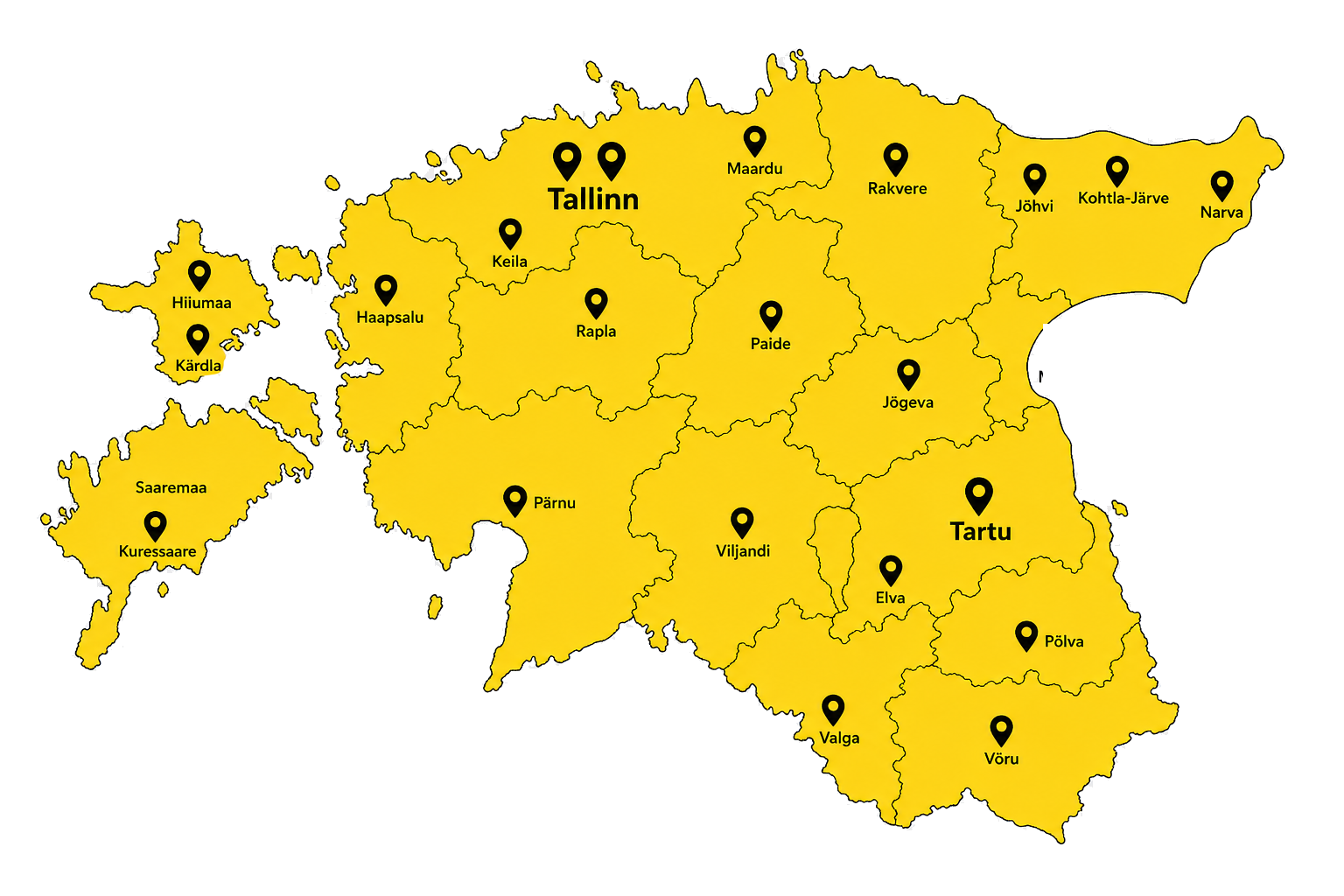
Our primary service area is Tallinn and Harjumaa, but we travel throughout Estonia. In Tallinn, we usually reach emergency call-outs within 30–60 minutes; in Harjumaa, within 1–2 hours.
Sõidame välja kogu Eestis. Avariitööd ööpäevaringselt, 7 päeva nädalas.