New Water Heater Installation
Location selection, wall or floor mounting, plumbing construction, safety valve and expansion tank, electrical connection, and startup with pressure testing.

We install new water heaters and replace old ones in flats, private homes, and commercial premises. We select the correct capacity and mounting, build a proper water connection with a safety valve and expansion tank, connect the electricity, and commission the unit on-site. Serving Tallinn and Harjumaa, and throughout Estonia when needed.
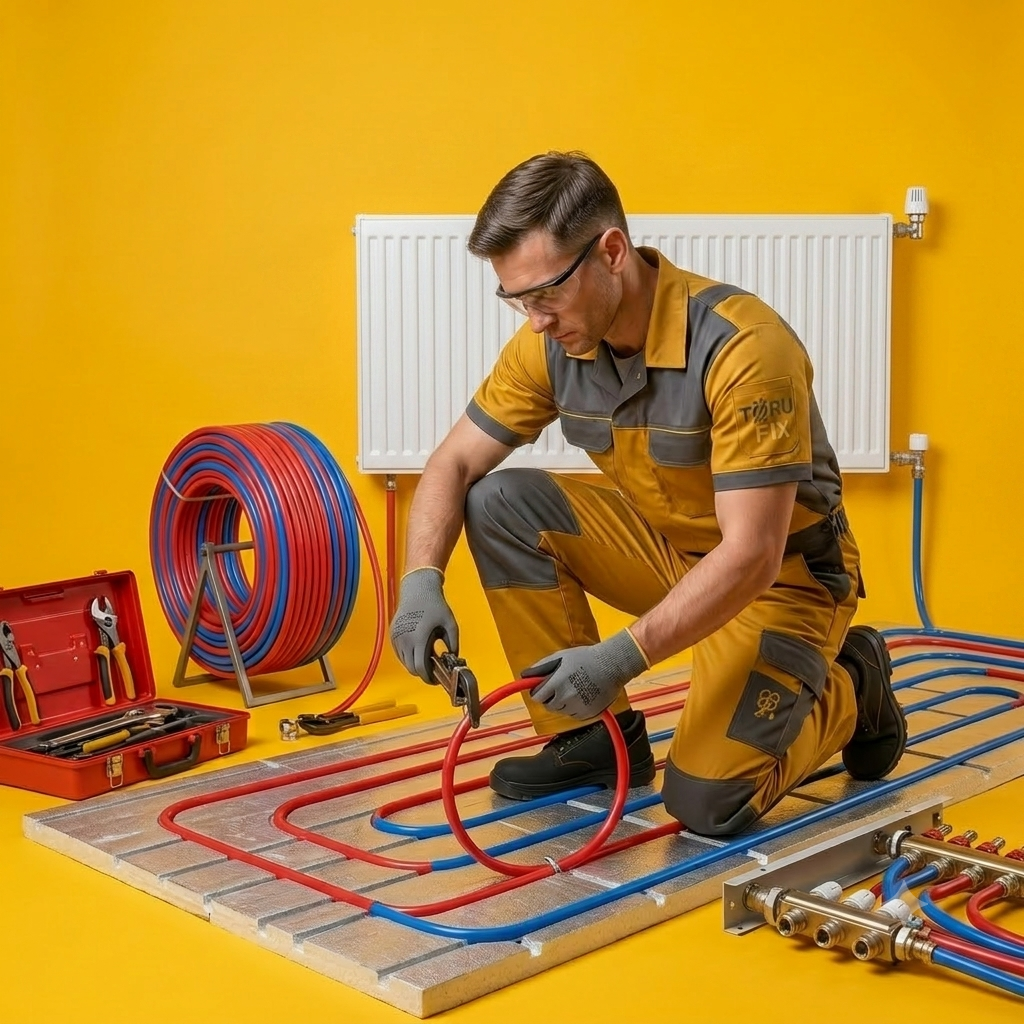
Location selection, wall or floor mounting, plumbing construction, safety valve and expansion tank, electrical connection, and startup with pressure testing.
Draining and dismantling of the old unit, tidying connections, installation of a new water heater in the same or a new location, and removal of the old unit.
Tank draining, descaling of the heating element, replacement of the magnesium anode, inspection of seals and safety valve, and thermostat adjustment.
Identifying the cause of a dripping safety valve, replacing the heating element and thermostat, checking connections and tank for leaks, and assessing if replacement is necessary.
Dispetšer vastab ööpäevaringselt. Peatame kahju leviku, lokaliseerime lekke ja sõidame välja ka öösel ning pühade ajal.
+372 58 024 476A water heater is one of the few household appliances that operates under pressure, is constantly filled with water, and is connected to both the water supply and electricity simultaneously. This combination makes installation a job where any mistake will eventually cost significantly more than a proper installation from the outset. An incorrectly chosen mounting, a missing expansion tank, or the wrong safety valve may not show symptoms in the first year – the problem emerges when the tank has already leaked or the heating element has burned out.
ToruFix OÜ installs and replaces water heaters in Tallinn and Harjumaa: in flats, terraced houses, private homes, summer cottages, and smaller commercial properties. We carry out both quick replacements of a single unit onto existing connections and complete solutions that require building new pipework, installing shut-off valves, a safety valve, an expansion tank, and arranging drainage. The work always concludes with commissioning, pressure testing, and adjustment – we leave the site with the unit operating and connections dry.
On this page, we explain when it's worth replacing a water heater and when maintenance is sufficient, how to choose the right capacity and type of water heater, what installation technically involves, what the most common mistakes are that we later have to fix, and what influences the price of water heater installation and replacement. The content is based on the work our technicians carry out weekly across sites in Tallinn and Harjumaa.
The clearest sign that replacement is needed is a tank leak. If water is coming from under or around the edge of the water heater's casing, the tank has corroded through, and it cannot be reasonably repaired. The internal enamel layer is damaged, and every extra hour increases the risk of tens of litres of water flooding the floor at once. In such a situation, we shut off the water supply, drain the tank, and replace the unit.
Another common situation is recurring faults. If the heating element burns out multiple times in a short period, the thermostat fails to maintain temperature, or the automation switches off randomly, it's either due to rapid limescale buildup from very hard water or general aging of the unit. For a water heater around ten years old, repeated repairs are usually more expensive than a new unit with proper installation.
A third reason is incorrect capacity or location. We are very often called because the family has grown, a bath has been replaced with a larger one, or the water heater needed to be moved during a kitchen renovation. In such cases, it's not a fault, but a need to re-plan the hot water solution.
Maintenance is sufficient if the tank is intact and the unit is working, but the water heats slowly, electricity consumption has increased, or boiling and rattling sounds are coming from the tank. These are typical signs of limescale. In this case, we drain the tank, clean the heating element, replace the magnesium anode and seals, and check the safety valve – after this, the unit usually works for many more years.
Choosing a water heater isn't just about litres. Different types of units behave completely differently: how much hot water they provide at once, how much electrical power they require, how much space they occupy, and how easy they are to maintain later. In practice, the choice comes down to four main types.
The most common solution in Estonian flats and private homes. The tank keeps a certain volume of water hot, and the heating element switches on according to the thermostat setting. The advantage is modest electrical power – usually 1.5–2 kW, which fits within the capacity of existing electrical installations even in older buildings.
The disadvantage is recovery time: if the tank is emptied, it takes one to three hours, depending on capacity, for a new batch to heat up. This is why capacity selection is more important than the brand of the unit.
Heats water instantly as it flows through the unit. There is no tank, so there's no heat loss from standing water, and the unit takes up very little space. Suitable for summer cottages, under a small kitchen sink cabinet, or situations where hot water is needed infrequently and in small quantities.
The limitation is electrical power. For a decent shower, an instantaneous unit requires a three-phase connection and a significant power reserve, which is often not available in a standard flat. Before recommending such a solution, we always check the main fuse size and cable cross-section.
Contains a heat exchanger coil heated by a boiler, heat pump, or heating unit. Electricity is used only as supplementary heating or during seasons when the primary source is not operating. In a private home with existing gas, pellet, or heat pump heating, this is usually the most economical way to produce hot water.
Installation is more complex than a standard water heater because it involves connecting the heating circuit, circulation pump, and automation. We perform this work with a heating system inspection to ensure the heat source capacity and water heater coil capacity are compatible.
Uses ambient air heat to produce hot water and therefore consumes significantly less electricity than a classic heating element. Suitable for private homes with a sufficiently large utility room and where air can be drawn in and exhausted.
The unit is taller and heavier than a standard water heater and requires condensate drainage. Such a solution is rarely feasible in a flat, but in a private home, the investment pays off with long-term use.
Incorrect capacity is the most frequent decision regretted later. A too-small water heater means that another family member will run out of hot water during a shower, and the unit will constantly operate at maximum load. A too-large water heater constantly keeps an excessive amount of water hot, leading to daily heat loss and a higher electricity bill without any benefit.
When estimating capacity, we consider family size, whether a shower or bath is used, the number of taps, overlapping consumption times in the morning and evening, and whether the household has a dishwasher and washing machine with their own water heating. Shower consumption is about 40–60 litres at a time, filling a bath 150–180 litres – the difference is significant and determines the choice.
As a practical guideline, 30–50 litres is suitable for one person, 80 litres for two, 100–150 litres for a family of three to four, and 150–200 litres for regular bath use. These are starting points, not strict rules – we will clarify them with you on-site, as the habits of the same family can double consumption.
Location is as important as capacity. The water heater should be as close as possible to the most frequently used taps, as every metre of pipework means waiting time and heat loss. Sufficient free space must be left below for heating element and anode maintenance, the wall must support the weight of the filled unit, and drainage must be nearby for the safety valve and emptying.
We begin with an inspection. We examine the existing connection, water pressure, mounting wall, electrical panel, and drainage possibilities. Only after this can we say whether a simple replacement onto existing connections is suitable or if pipework and electrical systems need to be rebuilt. This difference can be hours and double the price, which is why we do not give a final price over the phone.
For an old unit, we shut off the water, disconnect the electricity, drain the tank into a drain with a hose, and remove the water heater. We can take away the old unit if desired. For new installations, we fasten anchors to the wall whose load-bearing capacity matches the weight of the filled unit – for plasterboard walls or thin partitions, we use through-fastening or a separate support frame.
Next, we build the water connection. On the cold water pipe, we install a shut-off valve, a safety valve, a non-return valve, and a pressure reducer if necessary. The safety valve outlet is always directed to a visible drain – it must not be blocked or capped. On the hot water pipe, we install a shut-off valve so that the unit can be disconnected for later maintenance without shutting off water to the entire flat.
If there is a non-return valve and a closed system in the building, we install an expansion tank. Water expands by approximately 2–4% when heated, and if it has nowhere to go, pressure builds up, causing the safety valve to open during each heating cycle. This is the most common reason for a dripping safety valve – the solution is not to replace the valve but to install a missing expansion tank.
Finally, we fill the tank, bleed the system, connect the electricity, check the earthing and residual current device operation, and commission the unit. We inspect all connections in the pressurized system, set the temperature, and explain to the client how to maintain the unit and what constitutes normal safety valve behaviour.
The most common mistake is a missing or incorrect safety valve. A safety valve is not an accessory – it is the only thing that prevents the tank from rupturing due to overheating or pressure buildup. We regularly see installations where the valve has been omitted, set to the wrong pressure, or its outlet has been capped because "it was dripping". Dripping is a symptom, not a defect – and the correct solution is an expansion tank.
Another frequent mistake is inadequate mounting. A filled 100-litre water heater weighs over 120 kilograms, and this load hangs on two anchors. A unit mounted to plasterboard or aerated concrete without suitable fixings will eventually fail. We have seen units come off the wall along with the pipework – the result is flooding and often also repairs to neighbouring flats.
A third mistake is a forgotten magnesium anode. The anode is an inexpensive consumable that corrodes instead of the tank. If it is not replaced, the tank itself will start to corrode, and the unit's lifespan will be significantly shortened. Most of the "unexpected" tank leaks we encounter are actually the result of an anode not being replaced for years.
A fourth mistake is electrical negligence: an ungrounded unit, inappropriate cable cross-section, a missing residual current device, or a socket in a wet area. The combination of water and electricity offers no second chances – we always check these points, even if we are simply replacing an old unit with a new one.
A fifth mistake is the absence of shut-off valves. If the water heater cannot be isolated, any subsequent maintenance means shutting off the water to the entire flat or house, and in apartment blocks, often involving the apartment association. Two valves during installation save a lot of time and money over the years.
A water heater is one of the few appliances whose lifespan directly depends on maintenance. A properly installed and regularly maintained unit (every couple of years) will last 10–15 years. An unmaintained unit, especially in areas with hard water, can fail within five to six years.
During maintenance, we drain the tank, remove limescale from the heating element, inspect and replace the magnesium anode, replace the flange gasket, check the safety valve operation, and adjust the thermostat. If there is a thick layer of sediment at the bottom of the tank, we flush it out – this sediment causes the boiling and rattling sounds that clients often describe.
Thermostat setting affects both consumption and safety. Too low a temperature, below 55 degrees, promotes bacterial growth in the tank. Too high a temperature, above 70 degrees, accelerates limescale formation and increases the risk of scalding. In most cases, a reasonable setting is around 60 degrees.
If the water is very hard, consider installing a water filter or softener. This reduces limescale buildup throughout the household – not just in the water heater, but also in taps, shower systems, and household appliances. We assess water quality on-site and honestly tell you if such an investment would pay off for your property.
In flats, the main limitations are space, the wall, and electrical capacity. Water heaters are usually installed in bathrooms, toilets, or drying cupboards, and the choice often falls on narrow or horizontal models. The size of the main fuse determines whether an instantaneous solution is even possible – mostly it's not, and a storage water heater remains the choice.
In apartment blocks, you also need to consider apartment association rules and the condition of the risers. If the riser is old, it's sensible to also update the connections within the flat and install proper shut-off valves during water heater replacement. If shutting off the water affects the entire riser, we coordinate the time with the apartment association and complete the work in one visit.
In private homes, there is more freedom and more decisions to make. In the utility room, you can use a larger capacity, a floor-standing unit, an indirect water heater, or a heat pump solution. However, you must consider your own pump station or hydrofor, water quality from well water, and the fact that pressure can be uneven.
For summer cottages and seasonal properties, there is a separate requirement: the system must be drainable for winter. In such cases, we install a drain tap in the correct location and explain how to properly drain the water heater before the cold weather arrives – a frozen tank is permanently damaged.
The price is primarily determined by how much additional work is needed beyond just mounting the unit. The most affordable option is replacement onto existing, correct connections where the wall is load-bearing, valves are present, and the electrical socket is in the same place. The most extensive option is a first-time installation, where new pipework needs to be built, drainage installed, and a separate electrical line brought in.
The price is also affected by the unit's capacity and weight, the material of the mounting wall, accessibility to the installation site, the need for an expansion tank and pressure reducer, removal of the old unit, and whether the work is done during normal working hours or as an emergency outside working hours. In apartment blocks, coordination for water shut-off is sometimes an additional factor.
We do not give a final price over the phone because there are too many variables with water heater work that cannot be determined from a description. We provide a price range over the phone and a precise quote after an on-site inspection – before work begins and in writing. A warranty applies to our work and the materials we install, and we issue a proper invoice suitable for submission to both the apartment association and insurance companies.
ToruFix OÜ is a plumbing company operating in Tallinn and Harjumaa, whose technicians have daily experience with water systems in both old apartment buildings and new private homes. We carry out water heater work year-round and comprehensively: from replacing a single unit to building an entire hot water solution for a house, including heating and the heat sub-station.
We work comprehensively – one team performs both the plumbing work and the unit connection and commissioning, so the client doesn't need to search for another specialist separately. We use quality materials, document the work performed, and always explain why a particular solution has been chosen.
We respond to emergencies 24/7. If a water heater is currently leaking, we shut off the water, localize the problem, and provide either a temporary or final solution during the same visit. In Tallinn, we typically reach emergency call-outs within 30–60 minutes, and in Harjumaa within 1–2 hours.
Oleme 24/7/365 kõikjal Tallinnas ja Harjumaal.
Tuleme kohale kiiresti ja lahendame probleemi kohapeal.
Teeme tööd korrektselt ja anname garantii.
Selge hinnainfo enne tööde algust, üllatusi ei tule.
Aitame vormistada kahjujuhtumeid kindlustusseltsidele.
Helista või kirjuta – kirjelda probleemi paari lausega.
Ütleme tunnihinna ja eeldatava mahu enne kohalesõitu.
Tallinnas tavaliselt 30–60 minutiga, oma tehnika ja varuosadega.
Teeme töö, kontrollime süsteemi ja anname garantii.
If the pipes leading to the water heater are old, they are replaced with new ones during the water heater replacement.
water pipe replacementMaintenance of boilers, heating units, and indirect water heaters before the heating season begins.
heating system maintenanceHeating-side work often done alongside hot water solution upgrades.
radiator replacementGuide to descaling and cleaning the heating element, and when to call a professional.
cleaning an electric water heaterIf the water heater is leaking now and water needs to be shut off immediately.
24/7 emergency serviceIf the connections are existing and in good order, replacement usually takes 2–4 hours, including draining and removing the old unit. If new pipework needs to be built, an expansion tank installed, or a separate electrical line brought in, the work will take 5–8 hours or be done in two stages.
For one person, 30–50 litres is usually sufficient; for a couple, 80 litres; for a family of three to four, 100–150 litres. If a bath is used regularly, consider 150–200 litres. We will give a precise recommendation after assessing consumption habits and the property.
Most commonly, because the system is closed with a non-return valve and there is no expansion tank. As water heats, it expands, and the excess pressure is released through the safety valve. The solution is to install an expansion tank, not to close the valve – a capped safety valve is a direct hazard.
Yes, but only with the correct fixings. A filled 100-litre unit weighs over 120 kg, so we use through-fastening to the supporting structure or install a separate support frame. Standard plasterboard plugs are not suitable for such a load.
Every 2–3 years with normal water quality, and every 1–2 years with hard water. Maintenance includes descaling the heating element, replacing the magnesium anode, checking seals and the safety valve, and adjusting the thermostat.
Yes, if desired, we will take the old unit with us and hand it over for waste disposal. We agree on this when making the quote to include the time and transport in the work.
Usually not for replacing the unit itself inside the flat. Permission or coordination is needed if the work requires shutting off the riser or affects the common pipework of the building. In such cases, we coordinate the time with the apartment association and complete the work with the shortest possible water interruption.
We connect standard water heaters to existing, compliant sockets or junction boxes ourselves, checking earthing and the residual current device. If a new line from the fuse box or a fuse box modification is needed, we involve an electrician and agree on this beforehand.
A standard water heater heats water with an electric heating element. An indirect water heater has an internal heat exchanger heated by a boiler or heat pump, with electricity used only as a supplement. If the house already has a heating boiler or heat pump, indirect heating is usually a significantly cheaper way to produce hot water.
Yes, we provide a warranty on both the work performed and the materials we install. We issue a proper invoice suitable for submission to both the apartment association and insurance companies.
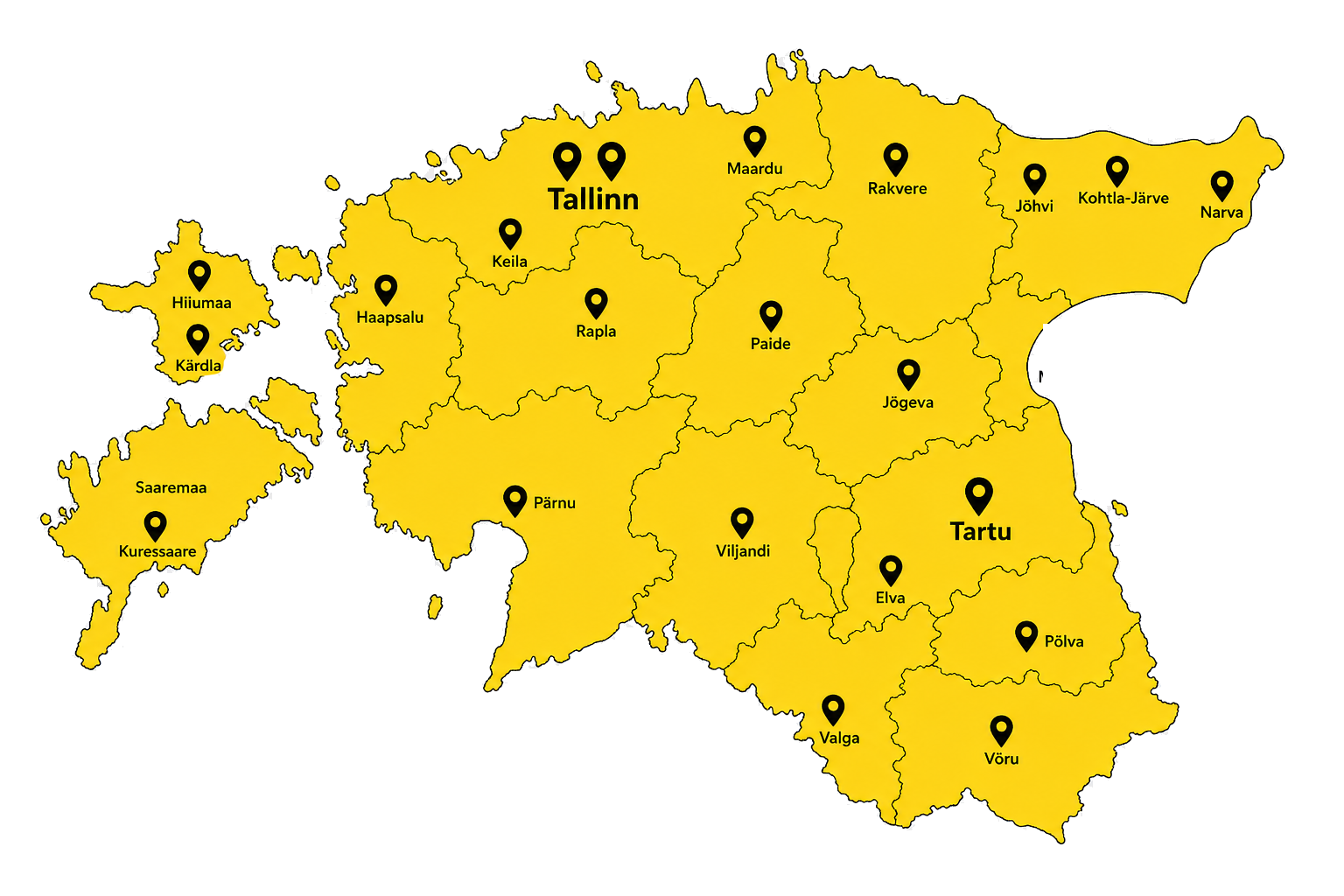
Our primary service area is Tallinn and Harjumaa, but we travel throughout Estonia. We respond to emergency call-outs for leaking water heaters 24/7.
Sõidame välja kogu Eestis. Avariitööd ööpäevaringselt, 7 päeva nädalas.