Water Main Construction from Connection Point to Building
Installation of pressure piping below frost depth, building entry, shut-off valves, and preparation for water meter unit.

We install internal water and sewerage mains from your building to the connection point: excavation, pressure piping and gravity-fed sewerage, manholes, pump stations, pipe insulation, and restoration works. We also replace old external mains and repair leaking supply pipes.
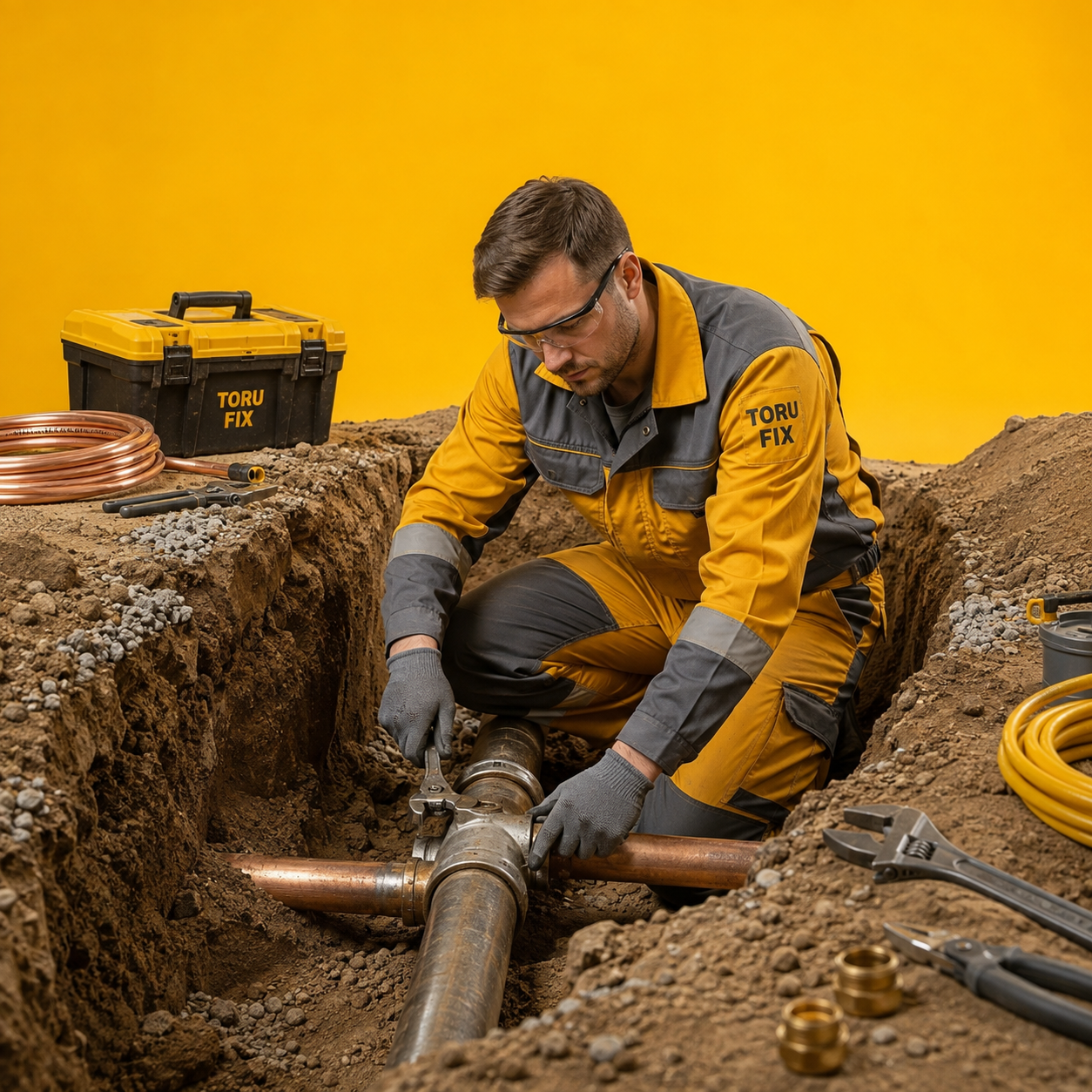
Installation of pressure piping below frost depth, building entry, shut-off valves, and preparation for water meter unit.
Construction of gravity-fed sewerage piping with the correct gradient, including inspection and observation manholes.
Main construction according to connection conditions and preparation for network operator inspection.
Pump station installation if a gravity-fed solution is not possible due to elevation differences, with automation and non-return valve.
Replacement of dilapidated cast iron, ceramic, or steel mains with plastic piping; repair of leaking supply pipes.
Trenching, sand bedding, layered backfill and compaction, and restoration of landscaping, paving, or asphalt to an agreed extent.
Dispetšer vastab ööpäevaringselt. Peatame kahju leviku, lokaliseerime lekke ja sõidame välja ka öösel ning pühade ajal.
+372 58 024 476The external main is the least visible part of a building's water and sewerage system: it's underground, rarely maintained, and only considered when something breaks. Yet, it's the external main that determines whether there's water in the building and if wastewater can be removed. While an internal pipe fault can often be resolved in a few hours, an external main failure means excavation, permits, and a significantly higher bill.
The external main starts at the connection point – where the network operator's responsibility ends, and the property owner's begins – and ends at the building's entry. This section must meet several technical requirements simultaneously: the pressure pipe must be below frost depth, the sewerage must have a consistent gradient without water traps, manholes must be maintainable, and the entire main must be surveyed for future location.
On this page, we explain what an external main consists of, how pressure piping differs from gravity-fed sewerage, how to connect to the public water network, the practical process from excavation to pressure testing, common faults that render external mains unusable within years, and how mains behave in winter. We undertake external main construction and replacement for detached houses, apartment associations, and commercial properties in Tallinn and Harjumaa.
An internal external main is not a single pipe but two separate systems, often running in the same trench but operating on entirely different principles. A water main is pressurised – water flows by pressure, and the pipe's gradient is not critical. A sewerage main is gravity-fed – water flows solely by gravity, and the gradient is the most important parameter in the entire system.
Pressure pipes and gravity-fed sewerage pipes differ in material, wall thickness, and connection method. A pressure pipe must withstand continuous internal pressure, while a sewerage pipe must withstand soil loads and have a smooth interior to ensure sediments flow. Mixing these up – for instance, using a sewerage pipe as a water main – will sooner or later lead to rupture and the risk of contamination by groundwater.
In the same trench, they may run in a specific relative position: the water pipe is generally installed above the sewerage pipe, so that in the event of a sewerage leak, wastewater does not contaminate the drinking water pipeline's surroundings. This is not a mere formality but a hygiene requirement.
New main construction is obvious when a building is being built or a property connects to the public water network. A more common and problematic scenario is the replacement of an existing main, the need for which arises gradually and is often noticed too late.
Excavation is the most expensive single component of external main works. Therefore, it makes sense to know exactly where the problem is before starting to dig, and whether the entire main needs replacement or just a section. Two days of diagnostics often save a week of excavation.
A camera is used to inspect the main from manhole to manhole, identifying faults and their locations: subsidence (water trap), broken pipe, shifted joint, root ingress, sediments. A sonde can pinpoint the problem area on the ground, meaning only one spot is excavated, not the entire length of the main.
Video inspection also answers whether blockages are due to internal plumbing or the external main. This distinction is crucial: an internal blockage is hours of work, while external main subsidence involves excavation.
A leak in a pressurised water main doesn't always reach the surface – water can travel dozens of metres along the trench's sand bed before emerging elsewhere. Thus, a wet patch on the lawn doesn't usually indicate the leak's location. We use pressure monitoring, acoustic listening, and, if necessary, tracer gas to ensure the excavation spot is as precise as possible.
Before excavation, it's crucial to know what else runs underground: electrical and communication cables, gas pipes, district heating mains, stormwater drainage. Their locations are identified based on documents and markings, and in questionable areas, manual excavation is performed. A damaged cable can turn a simple workday into a costly incident.
If a property connects to the public water and sewerage system for the first time, it's not just about pipework. Connection is a process where the network operator specifies the connection point and technical conditions, and the property owner builds their section of the main. Our role is the construction part: we build the main according to the conditions and prepare for inspection.
In practice, this means that before excavation, the connection point, the main's route on the property, depths, and requirements for manholes and materials must be established. If the main is built before conditions are clear, the trench often needs to be re-excavated – this is the most expensive way to save time.
If a house has previously used its own borewell and septic tank, connection doesn't just mean laying a new main. The old system must be properly decommissioned: the septic tank is emptied and either removed or filled, and the future use of the well is decided separately. It's crucial that the well's water piping and the public water network piping are not interconnected – this is a prohibited cross-connection that jeopardises the water quality of the entire network.
External main construction is a staged process where each subsequent step depends on the quality of the previous one. A trench with an uneven base will result in an incorrect gradient; poorly compacted backfill will subside a year later and pull the pipe with it.
We determine the main's route on the property, depths, manhole locations, and building entry point. We consider existing landscaping, driveways, tree roots, and other mains. At this stage, we also agree on the extent of restoration works – this often affects the price more than the piping itself.
The trench is excavated to the required depth, manually in confined spaces and near known cables. For deeper trenches, sloped sides or shoring are used – this is not a formality but a safety requirement, as collapsing soil is the most common cause of serious accidents in excavation work.
A sand bed is laid at the bottom of the trench to level the base and absorb point loads from stones. The piping is laid on the bed, sewerage pipes with a consistent gradient towards manholes, and water pipes below frost depth. Connections are made according to material specifications – welded joint, electrofusion coupling, or compression fitting – and each joint remains visible before covering.
Manholes are installed at changes in direction and connection points of the main and levelled so the cover is flush with the ground and can be opened. A wastewater pump station is installed if necessary. Building entry is made through a foundation penetration, with a protective pipe and seal, to prevent soil and water from entering the basement alongside the pipe.
The water main is pressure tested before backfilling the trench – this is the only moment when a potential joint fault is still cheap to fix. The sewerage main is inspected for gradient and flow, and with a camera if needed. Only a main that has passed testing is covered with soil.
The trench is backfilled in layers, and each layer is compacted. The correct material is placed above the pipe – large stones directly on the pipe will cause point loads and eventual rupture. In trafficked areas, compaction is especially important, as poorly compacted trenches will subside and damage asphalt. Finally, landscaping, paving, or surfacing is restored to an agreed extent.
The main is surveyed, and an as-built drawing is produced, showing its actual location and depths. This document has real value for future excavation works and property transactions – without it, the main will be sought with an excavator years later.
Today, external mains are predominantly constructed from plastic pipes. However, different plastics are not interchangeable, and each solution has its specific application.
Pressure pipe designed for drinking water and appropriate pressure is used for water mains. The pipe's pressure rating is chosen according to the network's operating pressure, and for long sections, coiled pipe is preferred as it reduces the number of joints. Every joint is a potential leak point – the fewer underground, the better.
For external sewerage, pipes designed for underground installation and capable of withstanding soil loads are used. Internal plumbing pipes are not suitable for external mains – they are designed for a different type of load. Pipe diameter is chosen according to the building's wastewater volume, not on the principle of "the thicker, the better": in too thick a pipe, water flows slowly, and sediments accumulate.
Plastic manholes are lightweight, watertight, and maintainable. The choice of cover depends on the load: a lighter solution suffices in green areas, while on driveways and car parks, the cover must withstand vehicle loads. Choosing the wrong cover is one of the most common reasons why a manhole subsides after a few years.
If the main cannot be laid below frost depth – for example, due to rocky ground or existing structures – insulation and, if necessary, a heating cable are used. This is a technically correct solution, but it requires an electrical supply and means a long power outage in winter will also become a water problem. If depth is achievable, depth is always more reliable than a cable.
Most external main problems arise not from material ageing, but from installation errors that only become apparent years later. These errors are almost always the same.
A frozen external main is one of the most common winter call-outs. Typical scenario: water suddenly disappears in the house after several frosty nights, but internal plumbing is warm and intact. The cause is almost always the same – the main is either too shallow, runs under an area without snow cover, or passes through a cold zone, such as a cleared driveway where snow, a natural insulator, has been removed.
Thawing is possible, but it's addressing the symptom. Once a main has frozen, it will recur every harsh winter until the depth or insulation is corrected. Therefore, we always handle freezing incidents in two parts: rapid restoration and then offering a permanent solution.
Gravity-fed sewerage requires wastewater to flow downhill all the way. If the building's sewerage outflow is lower than the connection point, or if the main is so long that the required gradient would place the pipe at an unreasonable depth, a gravity-fed solution is not feasible. In such cases, a pump station is used: wastewater is collected in a tank and pumped to the required elevation via a pressure pipeline.
A pump station is a reliable solution, but it introduces two new aspects to the system: electricity dependence and maintenance. A pump station requires periodic inspection, float switch cleaning, and tank washing. It's also important to consider that during a power outage, the pump station's tank has limited capacity – it's wise to know this before an outage actually occurs.
The external main is the only building system that virtually no one maintains before the first breakdown. Yet, proactive maintenance here is exceptionally cost-effective, because a breakdown is never repaired by just a plumber – it's repaired by a plumber with an excavator and restoration works.
The price of an external main is not determined by the piping itself, but by what is around and on top of the pipe. A main of the same length can cost very differently depending on whether it's excavated in a lawn or an asphalted car park.
We provide a quote after inspecting the site, as the margin for error when quoting remotely for external mains is too high. The quote separately details excavation, materials, pipework, and restoration – this shows what part of the cost comes from where, allowing the scope to be planned in phases if needed.
The nature of external main work is similar for every site, but the organisation differs completely depending on the client and who can tolerate disruptions during the works.
The most common jobs are replacing old supply pipes or connecting to the public water network. For detached houses, it's crucial to plan disruptions so the family can manage – we agree on when the water will be off and how temporary solutions will work.
An apartment building's external main serves dozens of flats, so disruptions must be planned and communicated in advance. We work with the association: we agree on the schedule, communication, and work phases, and issue invoices and documentation in a format suitable for the association.
For commercial properties, every hour of downtime is a cost, so critical changeovers are often performed outside opening hours. For new developments, we follow the project design and connection conditions, and hand over a surveyed and inspected main with as-built documentation.
The biggest risk with external mains is splitting the work among multiple contractors: one digs, another lays pipes, a third restores. Each handover point is where responsibility can be lost. We handle the entire chain as a single contractor – from diagnostics and excavation to pressure testing, restoration, and as-built drawings.
Oleme 24/7/365 kõikjal Tallinnas ja Harjumaal.
Tuleme kohale kiiresti ja lahendame probleemi kohapeal.
Teeme tööd korrektselt ja anname garantii.
Selge hinnainfo enne tööde algust, üllatusi ei tule.
Aitame vormistada kahjujuhtumeid kindlustusseltsidele.
Helista või kirjuta – kirjelda probleemi paari lausega.
Ütleme tunnihinna ja eeldatava mahu enne kohalesõitu.
Tallinnas tavaliselt 30–60 minutiga, oma tehnika ja varuosadega.
Teeme töö, kontrollime süsteemi ja anname garantii.
Replacement of internal sewerage piping – continuation of the external main.
sewerage pipe replacementReplacement of domestic water piping inside the building, starting from the entry.
water pipe replacementCamera inspection of external main condition before excavation.
video inspectionCleaning and emptying of external mains and manholes.
high-pressure jettingRemoval of groundwater from around the foundation, often performed with the same excavation work.
drainage installationSeparate system for roof and surface water, which must not be connected to foul drainage.
stormwater systemLocal solution on properties where connection to the public network is not possible.
septic tank installationInstallation of the meter unit and water meter after the building entry.
water meter unitAn external main is the property-internal water and sewerage piping from the connection point to the building entry. From the connection point towards the network, the network operator is responsible; from there towards the building, the property owner is. This is why the condition of the property's main is their own concern and cost.
The water main is installed below frost depth; the exact depth depends on the soil and the site and is determined on-site. If sufficient depth cannot be achieved, insulation and, if necessary, a heating cable are used.
Replacement of a short detached house supply main can be completed in one to two days; a longer main with manholes and restoration works may take a week or more. We provide an exact timeline after site inspection, as excavation conditions are the determining factor.
Disruption is only necessary for the duration of changeovers, not for the entire work period. We agree on the time of disruption in advance, and for apartment buildings, we notify residents beforehand.
No. If video inspection shows that only one section is faulty, only that section can be replaced. Replacing the entire main is sensible if the material is old and faults recur in several places – then a single job is cheaper than repeated excavation.
Gravity-fed sewerage relies on gravity and requires a consistent gradient. Pressure sewerage uses a pump station and is suitable when the outflow is lower than the connection point, or if the main would be too deep with gravity-fed operation.
No. Stormwater and foul water are separate systems. Discharging rainwater into the foul drainage system overloads the system, causing flooding during heavy rain and problems with the network operator. A separate system is installed for stormwater.
We stop work at that point, identify what it is, and agree on the next steps. To minimise this risk, we identify existing mains before excavation and manually dig in questionable areas.
Yes, to an agreed extent. The scope of restoration is agreed upon before work begins, as it significantly affects both the timeline and cost.
Yes. After completion of works, we provide an as-built drawing showing the actual location and depths of the main. This document is necessary for planning future excavation works and for property transactions.
Yes. Our emergency service operates 24/7/365, including public holidays. Night-time and holiday call-outs are more expensive than weekday visits, but rapid intervention is almost always cheaper than the consequences of waiting until morning.
Yes, we provide a warranty for both the work performed and the materials we install. We issue a proper invoice suitable for submission to apartment associations and insurance companies.
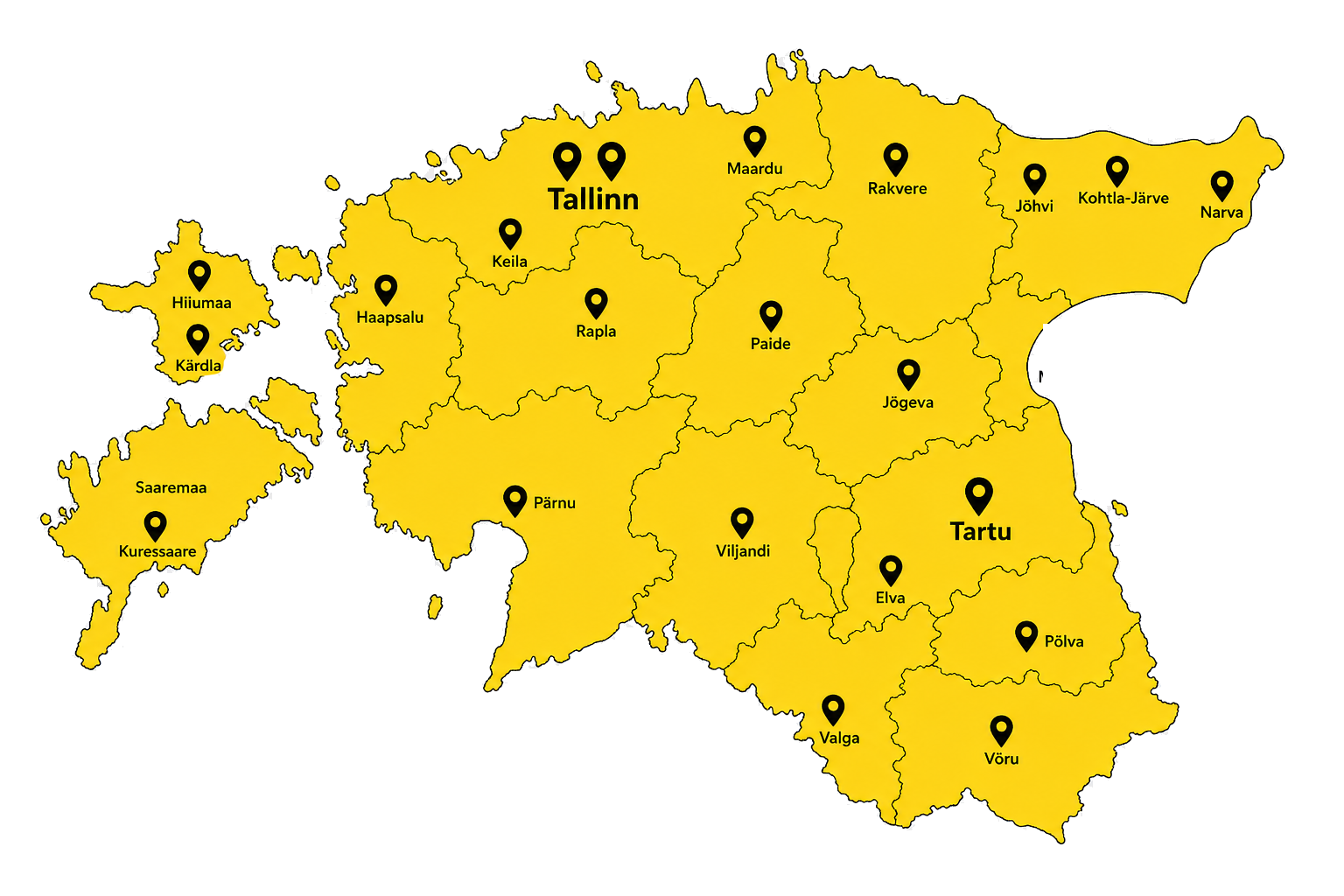
Our primary service area is Tallinn and Harjumaa, but we operate throughout Estonia. In Tallinn, we usually respond to emergency call-outs within 30–60 minutes; in Harjumaa, within 1–2 hours.
Sõidame välja kogu Eestis. Avariitööd ööpäevaringselt, 7 päeva nädalas.